
What Does an SDR Really Cost in 2026? The Math Most Teams Skip
Quick answer: The cost of hiring an SDR is far more than salary. Bridge Group's 2025 report puts median SDR on-target earnings at $80,000. Add employer taxes and benefits, a share of an SDR manager and recruiting, and one seat runs about $147,000 a year before tools, plus $5,475 to hire. Expect about 3 months of ramp and 40% median annual attrition.
A founder sees a job post listing a $55,000 base salary and budgets $55,000. That number is roughly a third of what the seat actually costs once commission, employer taxes and benefits, a manager's time and recruiting are added, and the first quarter buys very little pipeline.
The average new SDR needs 3.0 months to ramp, according to Bridge Group's 2025 research. This guide rebuilds the cost of hiring an SDR from primary sources, shows every formula, and converts the total into the only unit that matters for a budget decision: cost per held meeting.
The cost of hiring an SDR in 2026: what one seat really costs
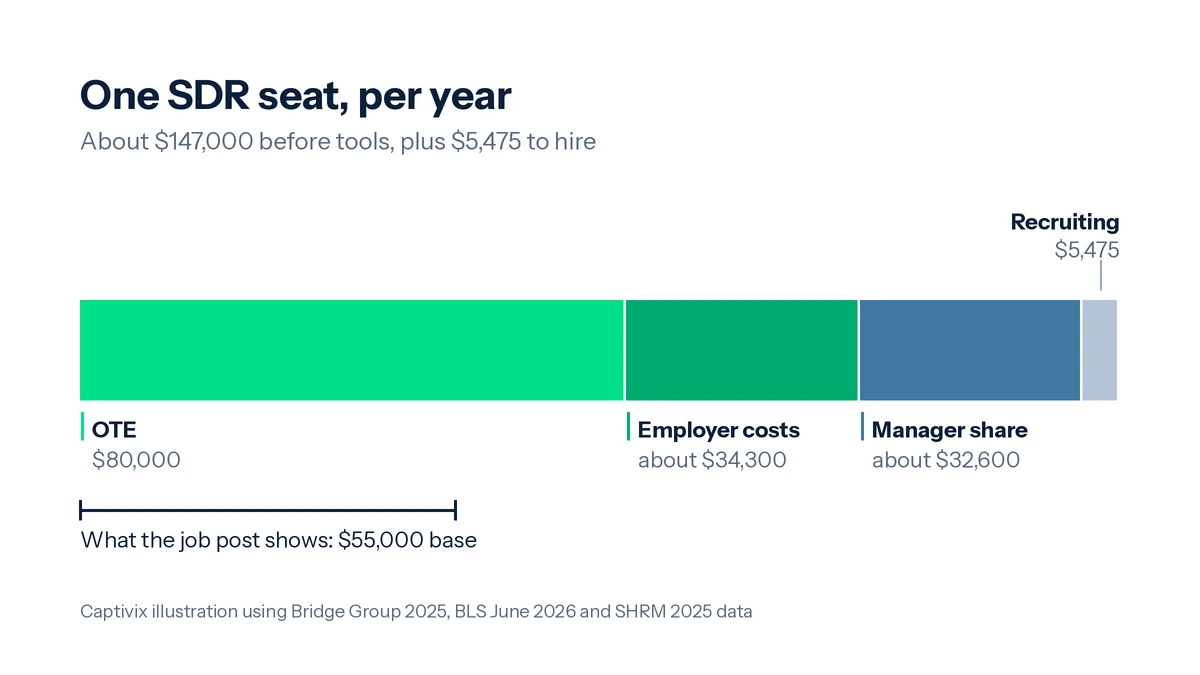
How much does it cost to hire an SDR? In a Captivix illustration built on Bridge Group 2025, BLS 2026 and SHRM 2025 data, one SDR seat costs about $147,000 a year before tools: $80,000 in OTE, about $34,300 in employer taxes and benefits, and about $32,600 for a share of a manager. Recruiting adds $5,475 per hire.
The fully loaded SDR cost starts with pay, then adds what the employer spends on top of it. BLS data for June 2026 shows wages and salaries were 70.0% of private industry employer compensation costs, so dividing pay by 0.70 approximates the full employer cost: $80,000 / 0.70 = about $114,300.
Fully loaded cost of one SDR seat, Captivix illustration using Bridge Group, BLS and SHRM data
| Cost line | Amount | How it is calculated | Source |
|---|---|---|---|
| OTE | $80,000 | Median $55,000 base plus $25,000 variable at quota | Bridge Group 2025 |
| Employer taxes and benefits | About $34,300 | $80,000 / 0.70 = $114,300, minus $80,000 | BLS ECEC, June 2026 |
| Share of an SDR manager | About $32,600 | $146,000 manager OTE / 6.4 SDRs per leader = $22,800, then / 0.70 | Bridge Group 2025; BLS June 2026 |
| Recruiting | $5,475 per hire | Average nonexecutive cost per hire; at 40% attrition, expect a refill about once every 2.5 years (about $2,200 a year) | SHRM 2025 |
| Tools and data | Your number | Annual quotes for CRM seat, contact data, sequencing, dialer and inbox infrastructure | Your invoices |
| Total annual seat cost | About $147,000 plus tools; about $152,400 in year one with recruiting | $114,300 + $32,600 = $146,900; year one adds $5,475 | Captivix illustration |
Treat the variable pay line with care. Only 60% of SDRs were at quota in Bridge Group's 2025 study, the lowest in its history, so actual commission may run below $25,000. Output usually falls with it, so cost per meeting rarely improves.
Adjusting the benchmark for services firms and contractors
Bridge Group's 2025 sample is 83% B2B SaaS, with median revenue of $47 million and a median deal size of $50,000. A 20-person engineering firm or a commercial contractor bidding on projects looks different, so adjust three lines before trusting the total.
Start with management. Bridge Group reports 3.6 SDRs per leader at companies under $5 million in revenue, versus 6.4 overall. At that ratio the manager share is $146,000 / 3.6 = about $40,600, or about $57,900 with employer costs, and the seat rises to about $172,200 (Captivix illustration). If the founder manages the rep instead, that cost moves into founder hours.
Then check pay and the meeting itself. BLS does not track SDRs as an occupation; a related federal benchmark, wholesale and manufacturing sales representatives, had a median wage of $76,460 in May 2025. In services and contracting, count meetings with a qualified buyer who has a real project, because those lead to proposals and bids.
SDR salary 2026: base, OTE and what reps actually earn
SDR salary in 2026 benchmarks still come from Bridge Group's 2025 report: a median $55,000 base and $25,000 in variable pay, for $80,000 in on-target earnings. That figure has not moved since 2022. OTE, or on-target earnings, is the total a rep earns at exactly 100% of quota, base plus commission.
The split is 68:32, so about a third of SDR OTE depends on performance. Bridge Group also reports that SDR OTE has grown just 0.56% a year in nominal terms over the past decade, well below inflation. Budget the full $80,000 anyway, because a plan that assumes misses tends to get them.
The hidden cost of hiring an SDR: ramp, attrition, management and tools
The hidden costs of hiring an SDR sit outside the offer letter. Per Bridge Group's 2025 report, a new rep needs 3.0 months on average to ramp, median attrition is 40% a year, someone has to manage the rep, and every seat needs tools. Each line below has a formula you can rerun with your numbers.
SDR ramp time
Ramp is the stretch between a rep's first day and full productivity, when they carry a full quota. Bridge Group's 2025 report puts average SDR ramp time at 3.0 months, the lowest since 2010 and down from a peak of 3.8 months in 2014. Some sites still quote 3.2 months or more; the primary report says 3.0.
\text{Ramp cost} = \text{monthly seat cost} \times \text{ramp months} \times (1 - \text{average productivity during ramp})At $146,900 a year, the monthly seat cost is about $12,240, so three months of ramp consume about $36,700 of annual cost. If the rep averages half of full output while ramping, the unproductive share is about $18,400 (Captivix illustration).
Add the hiring gap before ramp even starts. SHRM's 2026 benchmarking puts median time to fill for nonexecutive roles at 39 days, so the seat often sits empty for more than a month.
SDR attrition rate and tenure
Attrition is the share of reps who leave a role in a year, whether they quit, are let go or are promoted. Bridge Group's 2025 report puts median annual SDR attrition at 40%, with the middle half of companies between 21% and 57%, and average SDR tenure at 1.9 years. Promotions account for 16 points of that 40%.
\text{Turnover reserve} = \text{attrition rate} \times (\text{cost per hire} + \text{ramp cost of the replacement})At 40%, $5,475 and $36,700, the reserve is about $16,900 a year, or about $9,500 if ramp output averages half (Captivix illustration). Do not add it to a model that already counts only productive months, or you will count ramp twice.
Management time
Bridge Group's 2025 report puts first-line SDR manager OTE at $146,000, with 6.4 SDRs per leader. That is about $22,800 of manager pay per SDR, or about $32,600 with employer costs. A first SDR rarely gets a dedicated manager, which is why most report to a founder or sales leader.
If you manage the rep yourself, price your time. Weekly one-on-ones, call reviews, list approvals and message edits add up, so multiply your weekly hours by what an hour of your time is worth. That number belongs in the table even though it never shows up on payroll.
Tools and data
An SDR needs a CRM seat, contact data, a sequencing or email tool with sending infrastructure, a dialer or phone line, and often a LinkedIn seat. Prices vary widely by vendor, volume and contract length, so this guide assigns no dollar figure. Pull current quotes and add the annual total to the table.
Cost per qualified meeting: the number that actually matters
Cost per qualified meeting is the annual seat cost divided by the qualified meetings that actually take place in that year. It turns a salary debate into a unit you can compare across an in-house SDR, an agency and software. Count held meetings, not booked ones, because no-shows cost the same and produce nothing.
\text{Cost per held meeting} = \frac{\text{annual seat cost}}{\text{qualified meetings held per year}}Captivix illustration: assume a ramped SDR holds 10 qualified meetings a month. That is an assumption, not a measured average, though it matches the global median monthly quota of 10 held first meetings in Bridge Group's 2025 report. With 3 months of ramp, year one has 9 productive months.
That gives 10 × 9 = 90 held meetings, and $146,900 / 90 = about $1,630 per held meeting before tools. Including the $5,475 recruiting cost, it is about $1,690. At 6 held meetings a month, the same seat costs about $2,720 per meeting, and with only 60% of SDRs at quota, shortfalls are common.
A meeting booked but never attended still consumed research, outreach and calendar time, so track the show rate in your CRM. Our guide to booked vs held meetings explains how to define each. If you cannot track held meetings today, fix CRM discipline before you hire, because you will have no way to judge the rep.
A plug-and-play formula you can run in 10 minutes
You can model a fully loaded SDR cost in six steps: price OTE, add employer costs, allocate management, add tools and data, reserve for turnover and ramp, then divide by held meetings. The output is one number, your cost per held meeting, that you can compare against any alternative quote.
- OTE: start with your planned OTE; the benchmark is $80,000 (Bridge Group, 2025).
- Employer costs: divide OTE by 0.70 (BLS, June 2026), or use your payroll provider's figure.
- Management: manager OTE / reps per manager / 0.70, or your weekly hours × your hourly value.
- Tools and data: add your annual quotes for CRM, data, sequencing, dialer and inboxes.
- Turnover reserve: attrition rate × (cost per hire + ramp cost of a replacement); use 40% and $5,475 if you have no history.
- Divide: total annual cost / held meetings expected in productive months.
Think in three layers: a fixed cost (pay, employer costs, management), a variable execution cost (tools, data, recruiting, turnover) and a measurement unit (held meetings). Keeping them separate shows which lever moves your unit cost most.
In-house vs outsourced SDR vs AI with human review
In-house vs outsourced SDR is a trade between control and speed. An in-house rep costs about $147,000 a year before tools in the Captivix illustration and takes months to produce; an agency starts faster but controls the messaging; AI with human review moves fast while your team approves every message. Compare each on cost per held meeting.
Outsourced SDR cost is mostly vendor-published. Prospeo, a data vendor, reported in 2026 that appointment-setting retainers run $2,000 to $15,000 or more a month, and that per-meeting prices run about $50 to $300 for SMB targets, $300 to $600 for enterprise and $600 to $1,500 or more for C-suite. Treat these as vendor-sourced ranges and insist on held-meeting pricing.
In-house vs outsourced SDR vs AI: how the options compare
| Option | Cost model | Speed to first meetings | Control over messaging | Main risk | Best for |
|---|---|---|---|---|---|
| In-house SDR | Salary plus commission, employer costs, manager time and tools; about $147,000 a year before tools (Captivix illustration) | Slow: hiring, then about 3 months of ramp | High | 40% median attrition restarts the ramp | Proven message, a manager in place, deals that carry the seat |
| Outsourced SDR or agency | Retainer, pay per meeting or hybrid (vendor-sourced ranges above) | Moderate: weeks of onboarding | Medium to low | Padded calendars and loose definitions of qualified | Testing a market without hiring |
| AI only (fully hands-off) | Software subscription | Fast | Low | Off-brand or noncompliant outreach and damaged sending domains | Rarely right for considered B2B purchases |
| AI with human review | Software plus your reviewer's time | Fast | High: your team approves outreach before it goes out | Needs a defined ideal customer profile and a reviewer | Lean teams that want pipeline without a full seat |
For a closer look at software versus people, see our comparison of AI SDR vs human SDR.
Is it worth hiring an SDR? When the answer is yes
Is it worth hiring an SDR? Yes, when four things are true: your message and ideal customer profile already win deals, someone has time to manage the rep, your deal size covers a seat of about $147,000 a year (Captivix illustration), and you plan to keep reps well past ramp. Do not hire an SDR to find your message.
The deal-size test is simple arithmetic. If an average won deal brings $25,000 in gross profit, the seat needs about six SDR-sourced wins a year just to cover $146,900 (Captivix illustration). With average tenure at 1.9 years in Bridge Group's 2025 data, a rep who leaves at month 18 resets the clock.
Before opening a requisition, answer five questions:
- What is the unit of success: held, qualified meetings with a written definition?
- What is the fully loaded cost, using verified inputs rather than a job-post salary?
- What ramp do you assume, and what happens to pipeline in the first quarter?
- What is the turnover risk, and who covers the seat if the rep leaves?
- What alternative motion did you price against the hire?
Use one decision rule: if you cannot explain your SDR cost per held meeting in one sentence, the model is not finished.
How lean teams build pipeline without the full cost
Lean B2B teams can build pipeline without a full SDR seat by narrowing the target list, reaching accounts when there is a reason to buy, following up across several channels and counting only meetings that happen. The work still has to be done; the question is who does it and at what cost per held meeting.
Start with the founder or a senior seller running a focused outreach program for one quarter, tracking held meetings from day one. That gives you a conversion baseline before you commit to a $147,000 seat. Our guide on how to build a B2B sales pipeline without an SDR team walks through the system.
Then test channels with discipline. Results vary widely by list quality and offer, so set your own baseline and compare it with published cold email reply rate benchmarks before scaling volume.
How ATLAS fits
ATLAS by Captivix is one AI system that sells, bids and delivers. For pipeline generation, it builds your ideal customer profile, finds matching buyers, researches each company and person, scores and re-ranks leads every day, and books qualified meetings. See how ATLAS pipeline generation works.
ATLAS runs outreach across email, SMS, AI voice, LinkedIn and social, and your team approves the outreach before it goes out. At KE Staffing, an IT staffing and executive search firm, early results showed monthly touchpoints rising from about 3,000 to more than 4,500 and potential meetings from 18 to 28, as described in the KE Staffing case study.
AI voice outreach carries legal duties. The FCC ruled in February 2024 that AI-generated voices are artificial voices under the TCPA, so those calls require prior express consent. Read more in our guide to AI cold calling rules.
Frequently asked questions
How much does an SDR cost per year?
In a Captivix illustration, one SDR seat costs about $147,000 a year before tools: $80,000 median OTE from Bridge Group's 2025 report, divided by BLS's 0.70 wage share for June 2026, plus about $32,600 for a share of a manager. SHRM's 2025 average of $5,475 per hire adds recruiting.
What is the average SDR salary in 2026?
The most cited benchmark is Bridge Group's 2025 report of 351 B2B companies: a median base salary of $55,000 and median on-target earnings of $80,000, including $25,000 in variable pay. That OTE has not changed since 2022. Only 60% of SDRs hit quota, so many earn less than OTE.
How long does it take an SDR to ramp?
Bridge Group's 2025 report puts average SDR ramp at 3.0 months, the shortest since 2010 and down from 3.8 months in 2014. Add hiring time: SHRM's 2026 benchmark puts median time to fill for nonexecutive roles at 39 days. Plan on roughly four months from requisition to a productive rep.
What is the SDR attrition rate?
Median annual SDR attrition was 40% in Bridge Group's 2025 report, with the middle half of companies between 21% and 57%. Of that 40%, 13 points were involuntary, 11 voluntary and 16 promotions. Average SDR tenure was 1.9 years, so most seats need a replacement hire about every two years.
Is it cheaper to outsource SDRs?
Sometimes, on a monthly invoice. Prospeo, a data vendor, reported 2026 agency retainers of $2,000 to $15,000 or more a month and per-meeting prices of $50 to $1,500 or more, depending on target seniority. Compare on cost per held meeting, not monthly price, and get the definition of qualified in writing.
Is it worth hiring an SDR for a small business?
Only if your message already wins deals, someone can manage the rep, and your deal size covers a seat of roughly $147,000 a year in our illustration. Bridge Group's 2025 data shows companies under $5 million in revenue run 3.6 SDRs per leader, which raises management cost per rep. Many small firms should test pipeline before hiring.
The bottom line
The cost of hiring an SDR is about $147,000 a year before tools in our illustration, not the $55,000 on the job post, and the first quarter produces little. Divide your real seat cost by held meetings. If that number beats your alternatives and you can manage the rep, hire. If not, prove the pipeline first.
See your cost per meeting before you hire
Hiring a $147,000 seat to find out whether your market will take meetings is an expensive experiment. Book a walkthrough and we will show you the accounts ATLAS would find in your market, so you can judge the pipeline before you commit to headcount.
Related reading
Sources
Captivix illustrations combine these figures with stated formulas and assumptions; vendor pricing is labeled as vendor-sourced. Figures were checked in November 2026.
- Bridge Group, Sales Development Models, Motions and Metrics: 2025 Research Report (Matt Bertuzzi, February 6, 2025)
- U.S. Bureau of Labor Statistics, Employer Costs for Employee Compensation, June 2026 (released September 9, 2026)
- SHRM, SHRM Releases 2025 Benchmarking Reports (October 15, 2025)
- SHRM, 2026 Recruiting Executives Benchmarking
- U.S. Bureau of Labor Statistics, Occupational Outlook Handbook: Wholesale and Manufacturing Sales Representatives (May 2025 wages)
- Prospeo, Best Appointment Setting Services in 2026 (vendor-sourced pricing)
- Federal Communications Commission, Declaratory Ruling FCC 24-17 on AI-generated voices (February 8, 2024)