
Go-to-Market Strategy for 2026: How to Build a GTM Plan That Fits How B2B Buyers Actually Buy
How to Build a GTM Plan That Fits How B2B Buyers Actually Buy

A lot of go-to-market advice is still written as if B2B buyers want to talk to sales early, sit through generic demos, and patiently wait for a vendor to explain the category to them. That is no longer how most buying journeys work.
Research from Gartner shows that 61% of B2B buyers prefer a rep-free buying experience, and 73% actively avoid suppliers that send irrelevant outreach. Buyers now spend only 17% of their purchase journey meeting with suppliers — meaning any single vendor often gets only a sliver of real attention.
That changes what a modern go-to-market strategy has to do.
A GTM strategy is no longer just a launch document for internal teams. It is a system for helping buyers understand the problem, recognize your value, compare options, and move forward with confidence before they ever talk to a salesperson. If your content, channels, and sales motion are not built for that reality, your go-to-market plan will look complete on paper and underperform in the market.
What a Go-to-Market Strategy Is (and Is Not)
A go-to-market strategy is the plan a company uses to bring a product or service to its target customers, generate pipeline, and convert that pipeline into revenue. It defines who you sell to, how you reach them, what motion you use, how you price the offer, and how you measure success.
What a GTM strategy is _not_:
- A one-time launch plan that lives in a slide deck
- A synonym for "marketing strategy" — GTM is broader and includes sales motion, pricing, and channel design
- A static document — the best GTM plans are living systems updated by real buyer and pipeline data
The clearest way to distinguish a strong GTM strategy from a weak one: a strong plan explains _how_ the company will reach qualified buyers, create confidence, and generate pipeline consistently. A weak plan just lists channels and calls that a strategy.
When Companies Need a GTM Strategy
Every revenue-generating business has a de facto GTM approach, whether it is written down or not. But a _deliberate_ go-to-market strategy becomes essential in specific situations:
- Launching a new product or entering a new market — Without a clear plan, early spend is wasted on the wrong channels and the wrong buyers.
- Scaling past early traction — What worked for the first 10 customers rarely scales to 100 without a defined motion and channel mix.
- Repositioning against competition — A positioning refresh without a GTM plan is just messaging work. The plan is what translates the new position into pipeline.
- Improving pipeline quality or conversion — If win rates are low or CAC is climbing, the root cause is usually in the GTM strategy, not just the sales team.
- Entering a new buyer segment or industry vertical — A different ICP typically needs a different motion, channel mix, and content architecture.
The Modern 7-Stage GTM Workflow
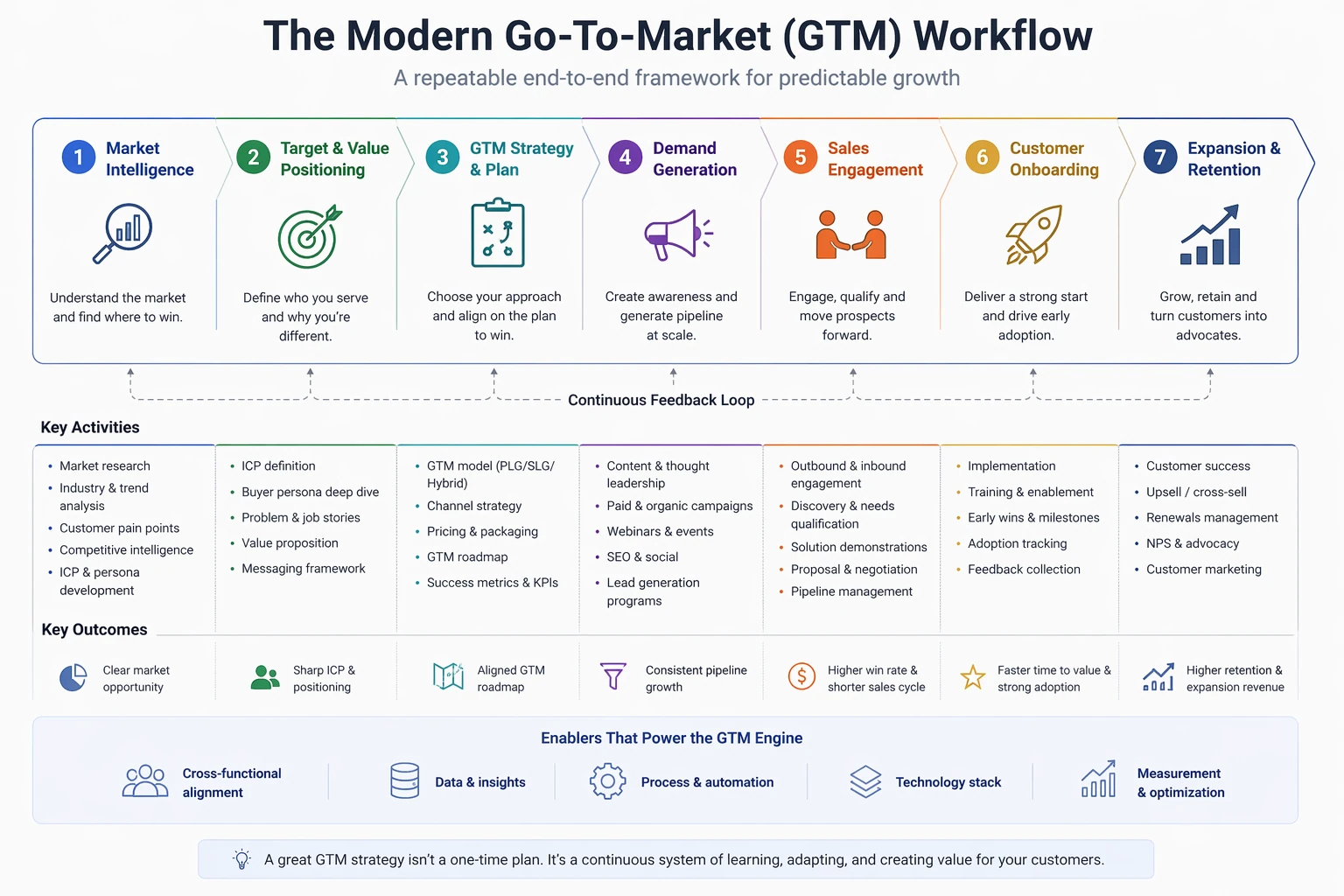
A repeatable GTM system moves through seven connected stages. The diagram below shows how each stage builds on the last — and how a continuous feedback loop keeps the system improving over time.
The seven stages — Market Intelligence, Target & Value Positioning, GTM Strategy & Plan, Demand Generation, Sales Engagement, Customer Onboarding, and Expansion & Retention — are connected by a continuous feedback loop. Data from later stages (win rates, onboarding activation, churn signals) should directly inform decisions in the earlier stages.
The bottom of the diagram highlights the four enablers that power the entire engine: cross-functional alignment, data and insights, process and automation, technology stack, and measurement and optimization. GTM strategies that ignore these enablers tend to plateau quickly.
The Six GTM Decisions That Matter Most
Within the framework above, six decisions determine whether a GTM strategy generates pipeline or just activity.
1. ICP and Market Problem
Define the ideal customer profile and the problem you want to win around. Not the whole market — the specific customer where your message is most credible, your product is most differentiated, and your deal path is most predictable. A vague ICP produces scattered pipeline and long sales cycles.
For staffing and HR-tech teams, this means going beyond firmographics. The strongest ICPs also describe the _triggering event_ — the situation that makes a buyer start looking. For ATLAS, that trigger is often a firm hitting a growth wall caused by disconnected workflows and manual coordination across tools.
2. Positioning and Category Story
What category are you in? What painful or expensive problem do you solve? Why should a buyer choose your company over the status quo, a competitor, or doing nothing?
Weak positioning is the most common root cause of GTM underperformance. It creates confusion in messaging, makes sales cycles harder, and forces reps to over-rely on product features rather than business outcomes. A clear category story — one that explains what you are, who you are for, and why the alternative is worse — makes every downstream GTM asset more effective.
3. Motion Choice: Sales-Led, PLG, Hybrid, Partners
GTM motion is the structural decision that most teams undervalue. Your motion determines how pipeline is generated, how buyers move through the funnel, and what your revenue team actually does day-to-day.
- Sales-led (SLG): Outbound prospecting, ABM, demos, and a human-driven sales cycle. Best for complex products with high ACV and multi-stakeholder buying committees.
- Product-led (PLG): Free trials or freemium tiers let buyers experience value before a sales conversation. Scales well for lower-ACV tools with self-serve onboarding.
- Hybrid: Product-led front end with sales engagement triggered by usage signals or account intent. Increasingly common in B2B SaaS.
- Partner-led: Channel partners, system integrators, or marketplace listings generate pipeline. Effective for products that complement existing enterprise platforms.
The right choice depends on ACV, buyer complexity, product surface area, and competitive dynamics.
4. Pricing, Packaging, and Route to Market
A self-serve offer with enterprise-only pricing creates friction that kills conversion. A high-touch sales motion with low ACV creates economics that kill the business. Pricing and packaging must connect value, buyer expectations, and the sales effort required to close.
In practice, this means testing entry-point offers (POCs, limited deployments) that reduce buyer risk while proving value. Structured engagements are designed exactly this way — providing a defined period that de-risks the decision for enterprise and mid-market buyers before a full deployment commitment.
5. Demand Generation and Channel Mix
You do not need more channels for the sake of it. You need the right mix of search, content, outbound, partner influence, webinars, social proof, and sales follow-up for your specific buyer. For most B2B SaaS teams, the winning combination is not "SEO _or_ outbound" — it is content that captures intent, outbound that adds context, and sales conversations that happen after the buyer has enough confidence to engage.
The best GTM teams do not add channels — they get better at a small number of channels before expanding. Channel focus beats channel breadth at almost every stage.
6. KPIs and Feedback Loops
Traffic alone is not a GTM metric. Neither is a raw MQL count. A stronger set of measures includes:
- Qualified pipeline by source and segment
- Conversion rate by channel and motion
- Average sales velocity (time from first touch to closed-won)
- Demo-to-opportunity rate
- Win rate by segment and competitor
- CAC by motion
- Payback period by channel
These KPIs form the feedback loop that connects GTM execution back to strategy. Without them, you are flying blind. With them, you can identify which part of the funnel is leaking, which channels are over-indexed, and which segments are converting fastest.
How Modern B2B Buyers Actually Buy
McKinsey's 2024 B2B Pulse — based on nearly 4,000 B2B decision-makers across 13 countries — found a durable "rule of thirds": at any given stage of the buying journey, roughly one-third of buyers want in-person interaction, one-third want remote interaction, and one-third prefer digital self-serve. Buyers do not want one channel. They want optionality.
That finding has direct implications for GTM design:
- Your content must do serious sales work before a human ever enters the conversation
- Your website, blog, and resource center are effectively the first meeting
- Your outbound motion must add context and relevance, not just create noise
- Your product demos and POCs must be designed for buyers who have already done the research
This is also why search matters more than most GTM plans admit. A pillar article on your primary keyword is not just an SEO asset — it is a self-serve sales asset. Done well, the same page that ranks for relevant terms can convert readers through a template download, a scorecard, or a strategy session request.
The GTM strategies that underperform in 2026 are the ones still treating content as a brand exercise and search as an afterthought. The ones that outperform treat every high-intent page as a conversion asset.
Common GTM Mistakes That Kill Pipeline
Most GTM failures are predictable. These are the patterns that show up repeatedly:
- ICP too broad. Targeting "mid-market B2B companies" is not an ICP. A real ICP includes firmographics, the triggering situation, and the internal champion profile.
- Positioning by committee. When everyone adds something to the positioning statement, it usually ends up saying nothing clearly to anyone specifically.
- Motion mismatch. A complex enterprise product run with a PLG motion (or vice versa) creates conversion problems that look like sales or product problems but are really strategy problems.
- Content that informs but does not convert. Publishing thought leadership that does not connect back to a clear next step for the reader wastes reach.
- Measuring activity instead of outcomes. Email volume, blog posts published, and social impressions are activity metrics. Pipeline generated, demo-to-opp rate, and sales velocity are outcome metrics.
- No feedback loop from sales to marketing to product. GTM works as a system. If the insights from lost deals are not flowing back to positioning and content, the strategy does not improve.
The biggest underlying mistake is treating GTM as a launch event rather than an operating discipline. A launch is a moment. A go-to-market strategy is a repeatable system. Companies that build the system outperform companies that plan the launch.
GTM Example: B2B SaaS and Staffing/HR Tech
Here is how the six decisions above translate into a concrete GTM sketch for a B2B SaaS platform targeting staffing firms.
| GTM Decision | B2B SaaS / Staffing HR-Tech Example |
|---|---|
| ICP | Mid-market staffing firms (50–500 employees) using 4+ disconnected tools, hitting a growth wall from manual coordination between sales and recruiting |
| Positioning | The only agentic AI platform that replaces the staffing tech stack with an execution layer — not just another tool to manage |
| Motion | Sales-led with content-assisted discovery. Intent signals (blog views, webinar attendance) trigger outbound personalization |
| Pricing / Packaging | 90-day structured deployment at a fixed fee, followed by annual SaaS subscription — reduces commitment risk for first deal |
| Demand Generation | SEO-driven pillar content, LinkedIn thought leadership, industry webinars, vertical-specific outbound sequences |
| KPIs | Qualified pipeline by source, demo-to-deploy conversion rate, deploy-to-ARR rate, sales velocity, win rate by ICP segment |
For staffing teams specifically, this GTM model pairs well with an AI implementation roadmap that phases the deployment across recruiting, sales, and operations — making the ROI story easier to tell inside the buyer organization and reducing adoption risk.
If you are ready to explore what this looks like for your business, request a GTM strategy session with the Captivix team.
90-Day GTM Promotion Plan
Publishing is the start, not the finish. A pillar article on go-to-market strategy should be treated as a source asset for a 90-day promotion campaign across three phases: publish and seed, amplify, and convert and refresh.
The timeline below maps out a realistic promotion cadence. The goal is to turn one well-researched article into 12–16 weeks of channel-specific content and conversion activity — not just a single publish event.
A few principles that make this cadence work:
- Seed before you amplify. Internal linking, newsletter, and sales enablement come first (weeks 1–2) so the article has distribution before paid or partner amplification begins.
- Repurpose with purpose. Carousels, short videos, and quote cards are not afterthoughts — they are the same article reformatted for the channels where your buyer spends attention outside of search.
- Convert warm traffic. Month three retargeting is where the content pays off. Readers who visited the article earlier are now seeing bottom-funnel CTAs — demo, deployment scoping, or working session requests.
- Refresh on a cadence. A metadata and FAQ refresh in week 10 prevents the article from aging out of search rankings. A quarterly review in week 14 catches any changes in buyer intent or competitive positioning.
The teams that win with GTM content in 2026 are not the ones publishing the most. They are the ones building the clearest path from problem recognition to confidence to action.
If your current GTM plan is still a slide deck, that is the first thing to fix. Turn it into a system buyers can actually use — starting with a clear pillar page, a structured promotion plan, and conversion paths designed around how your buyers already research and decide.