Cold Email Reply Rates in 2026: What's Normal and What to Aim For
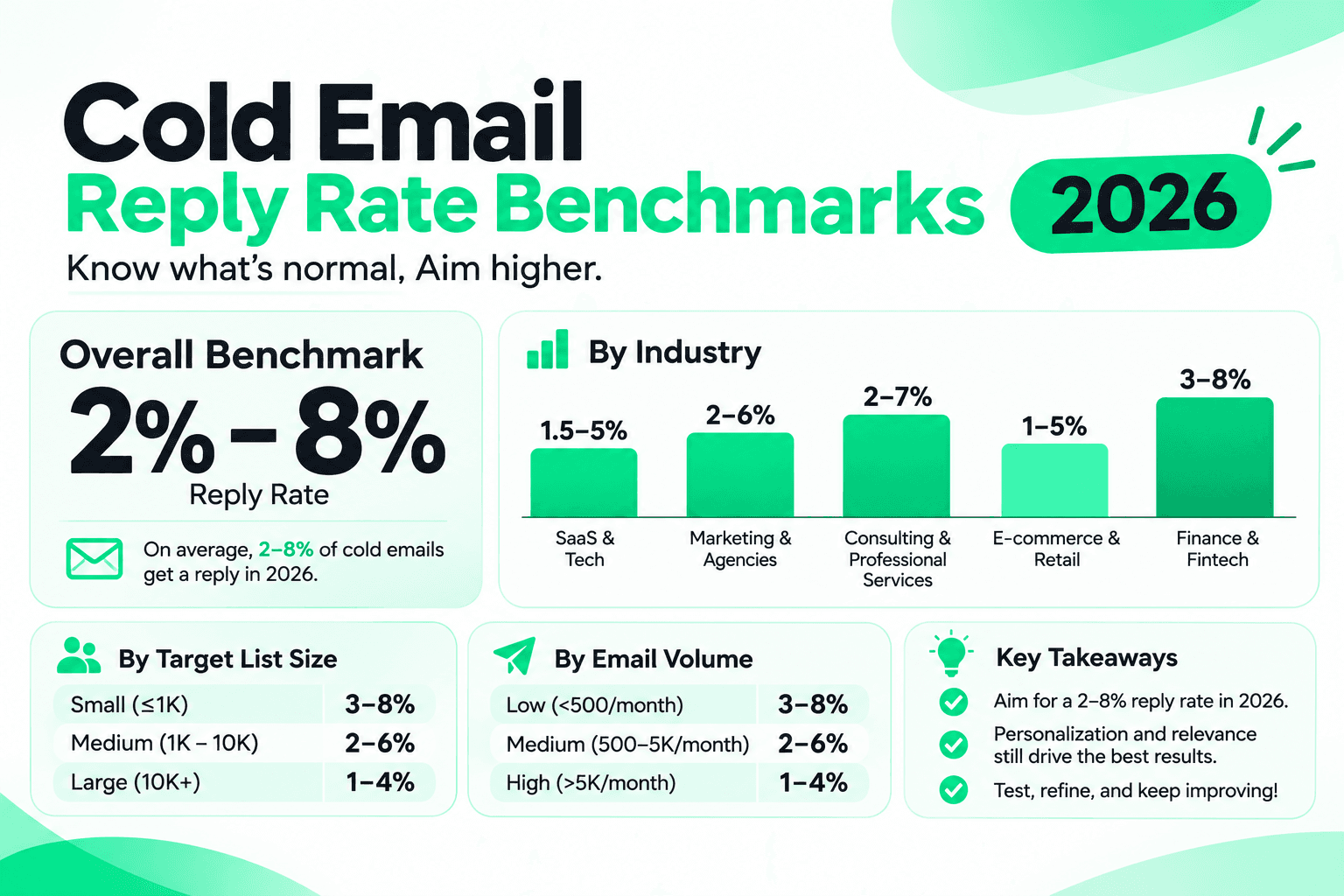
A founder sends 500 cold emails, gets 8 replies, and has no idea whether that is good. One site says 1% is normal. Another says 5%. A third promises 18%. Every cold email reply rate benchmark seems to disagree, and almost none explains why.
This guide fixes that. It lays out the 2026 benchmarks with their sources, explains why they range so widely, shows how to calculate your own reply rate, positive reply rate and meeting rate, and turns those numbers into the figure that matters for a small team: how many emails it takes to book a meeting. If you are still deciding how outbound fits your growth plan, start with how to build pipeline without an SDR team.
What is a normal cold email reply rate in 2026?
A normal cold email reply rate in 2026 is between 0.45% and 4.5%. Strict studies that count only human replies against every email sent land near the bottom of that range, while platform reports that count all replies against recipients land near the top. The average cold email reply rate you should compare against depends on which method you use.
Cold email reply rate benchmarks, 2026
| Source | What it measures | Average | Top performers |
|---|---|---|---|
| Instantly, 2026 report (2025 data) | All replies divided by emails sent | 3.43% | 5.5%+ top 25%, 10.7%+ top 10% |
| Hunter, 2026 report (31M emails, 2025) | Replies divided by sequence recipients | 4.5% overall, 3% for sales | 6.2% for sequences sent to 21 to 50 recipients |
| Belkins, 2026 study (7.5M emails, 2025) | Human replies divided by emails sent | 0.45% | 0.72% at companies with 0 to 10 employees |
| Smartlead, 2026 (850M+ emails, first half) | Replies divided by contacts, median sender | 0.74% | 2.63% top 10% |
Cold email reply rate benchmarks, 2026
For a sales team, Hunter's sales-only figure of 3% is the closest fit. Its 4.5% overall average blends in use cases with much higher reply rates, such as digital PR and recruiting outreach.
Why cold email benchmarks disagree
Cold email benchmarks disagree because they divide by different things and count different replies. One study divides by every email sent and ignores auto-replies; another divides by recipients and counts everything. As Belkins puts it, a 5% rate against openers and a 0.45% rate against total sends can describe the same campaign.
Why cold email benchmarks disagree: a reconciliation (Captivix analysis, 2026)
| Source | Sample and period | Divides by | Counts auto-replies? | Figure |
|---|---|---|---|---|
| Belkins, 2026 | 7.5M emails, 2025, agency campaigns | Emails sent | No | 0.45% average |
| Smartlead, 2026 | 850M+ emails, first half of 2026 | Contacts | Not stated | 0.74% median |
| Instantly, 2026 | Thousands of workspaces, 2025 | Emails sent | Not excluded | 3.43% average |
| Hunter, 2026 | 31M emails, 2025 | Sequence recipients | Not stated | 4.5% average |
| Belkins, 2025 (older method) | 16.5M emails, 2024 | Recipients who opened | Not stated | 5.8%, not comparable |
| Backlinko, 2019 | 12M link-building emails | Outreach emails | Not stated | 8.5%, outdated |
Denominator, auto-replies and mean versus median
The biggest driver is the denominator: per email sent, per recipient, per contact or per opener. Next is which replies count. Out-of-office notices, unsubscribe requests and polite refusals inflate totals unless a study removes them. Finally, averages get pulled up by a few strong senders; Smartlead's median sender reaches 0.74% of contacts while its top 10% reach 2.63%.
Sequences, use case, year and deliverability
Multi-step sequences add replies per contact, and Instantly attributes 42% of replies to follow-ups. Use case matters too: Hunter's data shows sales sequences at 3% against much higher rates for other kinds of outreach. Old studies, like Backlinko's 2019 link-building sample, are not comparable with 2025 sales data. And emails that land in spam cannot earn replies at all.
The practical rule: pick one benchmark, match its counting method, and compare your campaigns only against it.
What is a good cold email reply rate?
A good cold email reply rate for a small B2B team is 5.5% or more on the Instantly method, which counts all replies against emails sent. That puts you in Instantly's top quartile. If you count strictly, excluding auto-replies, aim for about double your own baseline instead, and confirm the gains show up as positive replies and meetings.
Cold email reply rate self-assessment, Captivix guidance (all replies divided by emails sent)
| Your rate | What it likely means | First fix |
|---|---|---|
| Under 1% | A deliverability or list problem, or you are counting strictly | Check authentication, keep bounces under 2%, test inbox placement, confirm your counting method |
| 1% to 3.4% | Below the platform average | Narrow segments, shorten email one, add 2 to 4 follow-ups |
| 3.43% to 5.5% | Average to good | Test offers and calls to action; track positive replies |
| 5.5% to 10.7% | Top quartile | Scale carefully and protect sending reputation |
| Above 10.7% | Top 10% | Confirm auto-replies are excluded before celebrating |
Before you score yourself, check five things. Are you measuring delivered emails, not just sends? Do you separate total replies from positive replies? Is each contact tied to a clear reason to reach out? Is every sequence checked for deliverability risk before you scale it? And do interested replies move into a defined handoff so they become meetings quickly?
Reply rate, positive reply rate and meeting rate
Reply rate counts every response, positive reply rate counts only interested responses, and meeting rate counts meetings that actually happen. Track all three, because a campaign full of objections and unsubscribes can post a high reply rate and still produce no pipeline. Positive reply rate is the share of contacts who reply with real interest.
Reply rate = replies ÷ emails delivered × 100Positive reply rate = interested replies ÷ emails delivered × 100Meeting rate = meetings held ÷ emails delivered × 100Emails per meeting = emails delivered ÷ meetings heldWorked example (illustration): a campaign delivers 2,000 emails and gets 80 replies, a 4% reply rate. Of those, 24 are positive, a 1.2% positive reply rate. Fourteen become booked meetings, a 0.7% cold email meeting rate, or about 143 emails per meeting.
From emails delivered to booked meetings (illustration)
Count meetings that are held, not just booked. A no-show costs the same research and outreach and produces nothing. More on that in our guide to booked versus held meetings.
How many cold emails does it take to book a meeting?
It takes roughly 760 cold emails to book one meeting at typical performance, about 300 at strong performance and about 140 at elite performance, using a four-email sequence. These are Captivix calculations from stated assumptions, not measured averages. Weak lists or poor deliverability can push the number past 2,500.
Emails per booked meeting by performance tier, Captivix calculation (4 emails per contact)
| Tier | Contact reply rate | Share of replies that are positive | Positive replies that book | Meetings per 1,000 contacts | Emails per meeting |
|---|---|---|---|---|---|
| Conservative | 1% | 30% | 50% | 1.5 | about 2,670 |
| Typical | 3% | 35% | 50% | 5.25 | about 760 |
| Strong | 5.5% | 40% | 60% | 13.2 | about 300 |
| Elite | 10.7% | 45% | 60% | 28.9 | about 140 |
Emails needed per booked meeting
Monthly capacity for a team without SDRs
Hunter's 2026 data shows reply rates peak at 20 to 49 emails per day per sending account, at 5.7%. Three mailboxes sending 40 emails a day for 21 working days is 2,520 emails a month. At the tiers above, that is about 3 meetings a month at typical performance, about 8 at strong performance and about 18 at elite performance (Captivix calculation).
What this means for cost per meeting
Cost per meeting is your monthly program cost divided by meetings held. The same math applies to a hire: see what an SDR really costs in 2026 for the salary side of that equation.
Cold email reply rate by industry, seniority and company size
Reply rates vary by who you email. In Belkins' 2026 study, founders and owners replied at 0.57%, C-level executives at 0.42% and VPs at 0.32%. Smaller companies replied more: 0.72% at firms with 0 to 10 employees, 0.49% at 11 to 50 employees, and 0.22% at companies with more than 10,000.
That favors teams selling to owner-led firms. Construction sat near the middle of Belkins' industry bands, at roughly 0.56% to 0.60% on its strict method. If you sell to construction firms, staffing firms or manufacturers, compare against your own baseline using the same counting method rather than a blended average.
Are cold email reply rates really dropping?
Yes, but less than headlines suggest. On a consistent method, Belkins measured a fall from 0.50% in the first half of 2025 to 0.40% in the second half, citing inbox saturation and stricter filtering. Many reported collapses, though, are method changes, such as a study switching from opens to total sends as its denominator.
Buyers have not given up on cold email. In Hunter's 2026 survey, 33% of decision makers replied to no cold emails in the past year, while 32% replied to five or more. The difference is relevance, not the channel.
Why open rate is not a benchmark anymore
Cold email open rate in 2026 is unreliable. Apple Mail Privacy Protection, launched in 2021, loads tracking pixels automatically, so opens get counted that never happened. Tracking can also hurt results: Hunter found campaigns without open tracking replied at 7.4%, against 4.4% with tracking. Measure replies, positive replies and meetings instead.
Deliverability and legal rules that cap your reply rate
An email that lands in spam cannot get a reply, so sender rules set a ceiling on every campaign. Gmail, Yahoo and Microsoft now require authentication, and US law sets rules for opt-outs and identification. Getting these basics right is the cheapest way to protect your cold email reply rate.
- Gmail. Since February 1, 2024, Google's sender guidelines require all senders to set up SPF or DKIM and keep spam complaints below 0.3%. Senders of 5,000 or more messages a day to personal Gmail accounts also need SPF, DKIM, DMARC and one-click unsubscribe for marketing messages.
- Microsoft. Since May 5, 2025, domains sending more than 5,000 emails a day to Outlook.com, Hotmail and Live addresses must pass SPF, DKIM and DMARC. Mail that fails is rejected, not sent to junk.
- US law. The FTC's CAN-SPAM guide says the law makes no exception for business-to-business email. Use accurate headers and subject lines, include a postal address and a clear opt-out, and honor opt-outs within 10 business days. Penalties reach $53,088 per violating email. This is not legal advice.
Most B2B prospects use business domains, so treat the Gmail thresholds as best practice rather than a legal line. Aim to keep spam complaints well under 0.1% and bounces under 2%.
How to improve your cold email reply rate
To improve your cold email reply rate, send fewer emails to better-fit contacts, tie each message to a reason to reach out now, keep the first email short, follow up three to five times, and protect deliverability. Change one variable at a time so you know what worked.
What top senders do differently
| Area | Average sender | Top sender in 2026 |
|---|---|---|
| List quality | Broad scraped lists | Verified contacts in a narrow segment |
| Reason to reach out | Generic value pitch | A recent trigger such as hiring, new leadership or expansion |
| First email | Long and about the sender | Under 80 words and about the buyer |
| Follow-up | One email, or one weak bump | 3 to 5 steps, each adding something new |
| Sending | Freemail or one overloaded mailbox | Custom domain, authenticated, 20 to 49 emails a day per mailbox |
| Measurement | Opens | Positive replies and held meetings |
Follow-ups
Follow-ups do much of the work. Instantly found 58% of replies came from the first step and 42% from follow-ups, and recommends 4 to 7 touches. Hunter found three total messages performed best in 2025, at 6.8% against 3.3% for a single email. A sound default is 3 to 5 steps, spaced 3 to 4 days apart.
List size, sending volume and personalization
Smaller, tighter sends win. In Hunter's data, sequences to 21 to 50 recipients replied at 6.2%, against 2.4% for sequences to 500 or more, and custom domains replied at 5.2% against 2.5% for freemail addresses. Instantly found elite first emails run under 80 words. Leading with a real buying signal helps most; see our guide to signal-based selling.
How ATLAS fits
ATLAS by Captivix is one AI system that sells, bids and delivers. With ATLAS pipeline generation, it builds your ideal customer profile, finds matching buyers, researches each company and person, scores and re-ranks leads every day, runs outreach across email, SMS, AI voice, LinkedIn and social, and books qualified meetings. Your team approves the outreach before it goes out.
Company knowledge lives in ATLAS Mind, so every message draws on what your team has approved. In the KE Staffing case study, Captivix reports a 96% inbox rate and more than 4,500 touchpoints a month.
Frequently asked questions
What is a good cold email reply rate in 2026?
Instantly's 2026 benchmark puts the average at 3.43% of emails sent, the top quartile at 5.5% and the top 10% above 10.7%, counting all replies. A small B2B team should aim for 5% or more on that method, or about double its own baseline, and judge results by positive replies and held meetings.
What is the average cold email response rate?
Published 2026 averages range from 0.45% (Belkins, human replies divided by 7.5 million emails sent in 2025) to 4.5% (Hunter, replies divided by sequence recipients across 31 million emails). Most of the gap comes from the denominator and whether auto-replies count, so compare your rate only against a benchmark that counts the same way.
What is the difference between reply rate and positive reply rate?
Reply rate counts every response divided by emails delivered or contacts emailed. Positive reply rate counts only interested responses, excluding auto-replies, unsubscribe requests and polite refusals. Positive reply rate predicts pipeline better, but no large public dataset publishes a reliable positive reply benchmark, so track your own baseline.
How many cold emails does it take to book a meeting?
Using a four-email sequence and stated assumptions, Captivix estimates about 760 emails per booked meeting at typical performance, about 300 at strong performance and about 140 at elite performance. Weak lists or poor deliverability can push that past 2,500 emails, which is why list quality matters more than volume.
How many follow-ups should a cold email sequence have?
Instantly recommends 4 to 7 touches and found follow-ups produced 42% of replies. Hunter found three total messages performed best in 2025, at 6.8% versus 3.3% for a single email. For most small teams, 3 to 5 steps spaced 3 to 4 days apart, each adding something new, is a sound default.
Why are cold email reply rates dropping?
Belkins measured a fall from 0.50% in the first half of 2025 to 0.40% in the second half on a consistent method, citing inbox saturation and stricter filtering. Gmail, Yahoo and Microsoft sender requirements raised the bar for authentication. Some reported drops are method changes, not real declines.
Is open rate still a useful cold email metric?
Not as a benchmark. Apple Mail Privacy Protection, launched in 2021, loads tracking pixels automatically, which inflates opens. Hunter's 2026 data also shows campaigns without open tracking replied at 7.4% versus 4.4% with tracking. Measure replies, positive replies and held meetings instead.
Is B2B cold email legal in the United States?
Yes, if it follows the CAN-SPAM Act. The FTC says the law makes no exception for business-to-business email. Use accurate headers and subject lines, include a valid postal address and a clear opt-out, and honor opt-outs within 10 business days. Each violating email can cost up to $53,088. This is not legal advice.
The bottom line
A normal cold email reply rate in 2026 sits between 0.45% and 4.5%, depending on how replies are counted. Pick one method, aim for the top quartile on it, and judge every campaign by positive replies and held meetings. For a small team, tight lists, short emails, steady follow-up and clean deliverability matter far more than volume.
Related reading: RFP win rate benchmarks for 2026.
See who would reply to you
Most cold email fails on the list, not the copy. Book a walkthrough and we will show you the accounts ATLAS would find in your market and what it would say to them.
Sources
Figures were checked in November 2026. Instantly, Hunter and Smartlead sell cold email software and Belkins is an outbound agency, so their figures are vendor data. Captivix calculations use the assumptions shown.
- Instantly, Cold Email Benchmark Report 2026 (updated January 12, 2026): instantly.ai
- Hunter, The State of Email Outreach 2026 (31 million emails, 2025 data): hunter.io
- Belkins, B2B Cold Email Response Rates, 2026 study (7.5 million emails, 2025 data): belkins.io
- Smartlead, The State of Cold Email 2026 (850 million+ emails, first half of 2026): smartlead.ai
- Google, Email sender guidelines (effective February 1, 2024): support.google.com
- Microsoft, Outlook requirements for high-volume senders (effective May 5, 2025), Microsoft Defender blog
- Federal Trade Commission, CAN-SPAM Act: A Compliance Guide for Business: ftc.gov
- Captivix, KE Staffing case study: captivix.com