
How to Build a B2B Sales Pipeline Without an SDR Team
Referrals dry up without warning. Founder-led selling fills the calendar in bursts, then stops the moment delivery gets busy. Hiring SDRs looks like the fix, but it takes months and a full salary before the first qualified meeting lands.
B2B pipeline generation can work without an SDR team. It takes a repeatable system: target the right accounts, reach them when they have a reason to buy, follow up across channels, and count only the meetings that actually happen. This guide covers the real costs, the 2026 benchmarks, and how a small team can run that system week after week.
What is B2B pipeline generation?
B2B pipeline generation is the work of creating qualified sales opportunities at a steady, predictable rate. It covers choosing target accounts, researching them, reaching out, following up and booking meetings that turn into real deals. It is different from lead generation, which stops at collecting contacts.
The distinction matters for a lean team. A list of names does not produce revenue. A calendar of held meetings with the right buyers does, and that is what pipeline generation is built to deliver.
Lead generation vs pipeline generation
| Dimension | Lead generation | Pipeline generation |
|---|---|---|
| Primary output | Contacts and inquiries | Qualified opportunities |
| Targeting | Often broad | Ideal customer profile plus buying signals |
| Where it stops | A form fill or a list | A held meeting that becomes an opportunity |
| Measured by | Volume of names | Held meetings, opportunities and pipeline coverage |
| Business impact | Top of funnel activity | Forecastable revenue |
Why the SDR model is hard for lean teams
The SDR model works for companies with a sales leader, a proven playbook and the budget to absorb a slow start. Lean teams rarely have all three. A new SDR costs a full salary from day one, takes about a quarter to ramp, and still needs someone to own targeting, messaging and coaching.
The numbers add up fast. According to Bridge Group benchmarks, US SDR base salary runs roughly $55K to $60K, on-target earnings run $85K to $90K, and ramp to full productivity takes about 3.2 months. That is a quarter of salary before the role pays for itself, and it does not include tools, data or management time.
Even a ramped SDR spends most of the week on work that is not selling. Corporate Visions research from 2025 found SDRs spend only 28% of their time actually selling, with the rest lost to research, data entry and admin. For a founder who has to manage that hire, the time cost lands on the person who can least afford it.
For a full breakdown of salary, ramp, tools and turnover, see the real cost of hiring an SDR.
The 5 parts of a pipeline generation strategy that doesn't need SDRs
A pipeline generation strategy without SDRs rests on five parts: a tight ideal customer profile, accounts with a reason to buy now, research before every first touch, multichannel outreach with real follow up, and tracking held meetings instead of booked ones. Each part replaces a job an SDR would otherwise do by hand.
1. Define a tight ideal customer profile
Start with the accounts you already win. List the industries, company sizes, buyer roles and business situations behind your best closed deals, then write down who you will not target. A narrow ideal customer profile makes every later step cheaper, because you research and contact fewer accounts that were never going to buy.
2. Find accounts with a reason to buy now
Fit tells you who could buy. Timing tells you who will. Buying signals such as new leadership, open roles in a relevant team, funding, expansion into new markets or a change in technology show that something at the account just changed.
Timing has a measurable effect. Accounts with active buying triggers showed a 37% win rate against 19% for cold accounts, according to Champify data cited by Salesmotion. Learn how to build outreach around those moments in signal-based outreach.
3. Research every account before reaching out
Before the first message, know what the company is dealing with and what the person you are writing to is responsible for. Look at recent news, hiring, leadership changes and the buyer's role. Research is what lets the first line of a message name something real instead of a generic compliment.
This is the step SDRs spend the most hours on, and the one most often skipped when a founder runs outreach alone. It is also the step that decides whether a message gets read.
4. Reach out across channels and follow up
Most replies do not come from the first email. Instantly's 2026 benchmark found that follow ups drive 42% of replies, so a one email campaign gives up nearly half its results. The same benchmark puts the average cold email reply rate at 3.43%, with the top quartile at 5.5% and elite senders above 10.7%.
Combine email with phone, LinkedIn and social so buyers see a consistent thread in the places they already spend time. See where your numbers stand with cold email reply rate benchmarks.
5. Book meetings, then track the ones that happen
A booked meeting is not pipeline until the buyer shows up. Show rates vary by how the meeting was set: Laxis reports that AI-booked meetings show up 60 to 70% of the time, against 75 to 85% for human-booked meetings. Confirm the agenda, send a short reminder, and report held meetings as your core number. More on this in booked vs held meetings.
Your options compared: in-house SDR, agency, AI only, or AI with human review
Lean teams have four ways to run outbound: hire an SDR, pay an agency, let AI run fully on its own, or use AI with a person approving the work. The right choice depends on how much control you need over your messaging and how much risk you can accept on meeting quality.
Four ways to run outbound pipeline generation without building an SDR team
| Option | Cost model | Speed to launch | Control over messaging | Meeting quality risk | Best for |
|---|---|---|---|---|---|
| In-house SDR | Salary plus commission ($85K to $90K OTE) | Slow, about 3.2 months to ramp | High, if someone manages it | Depends on hiring and coaching | Teams with a sales leader and a proven playbook |
| Outsourced agency | Per appointment or retainer ($550 to $1,700 per qualified appointment) | Fast | Low to medium | Medium, the agency serves many clients | Testing a new market quickly |
| AI only (fully autonomous) | Software subscription | Fastest | Low, no one reviews messages | High | High volume, low stakes offers |
| AI with human review | Software plus a few hours of review a week | Fast | High, every message approved | Lower, a person checks fit and tone | Lean teams selling high value services |
Agencies are the most common shortcut. They remove hiring risk, but the average cost runs $550 to $1,700 per qualified appointment based on Clutch data, and your brand is in the hands of a team writing for many clients at once.
Fully autonomous AI is the opposite trade: low cost, low control. In a July 2026 Belkins survey, 77% of teams using AI for lead generation could not confirm a positive ROI. Benchmarks from RevOps Co-op, reported for Q1 2026, put AI-booked meetings converting to opportunities at about 15%, against roughly 25% for human-booked meetings. Many AI SDR figures come from vendors, so treat them as directional. The pattern is consistent, though: AI is strong at research and volume, and a person reviewing the work protects quality.
For the full comparison, read AI SDR vs human SDR.
Outbound pipeline generation when your team is small
Outbound pipeline generation for a small team means fewer, better messages. Instead of blasting a large list, you contact a focused set of accounts, tie each message to something that changed at the company, and keep following up until you get a clear yes or no.
If you are figuring out how to build a sales pipeline from zero, start with a message framework you can reuse. The first line names the trigger you found. The second connects it to a problem that buyer is likely facing. The third makes one small ask, usually a short call. Nothing in the message should be about your company until the buyer has a reason to care.
Keep each channel doing its own job. Email carries the point of view. A call or voicemail adds a human voice for accounts that matter most. LinkedIn and social keep your name familiar between touches. Together they form one thread, not three separate campaigns.
Your buyers have already started without you
Most B2B buyers now research and shortlist vendors before they talk to anyone in sales. That makes timing and relevance more important than volume. If you reach a buyer after the shortlist is set, even a strong message arrives too late.
The shift is broad. Forrester's 2026 Buyers' Journey Survey of nearly 18,000 business buyers found 94% used generative AI in their most recent purchase. And 6sense research found 84% of B2B buyers have already picked a preferred vendor before they speak with a sales rep.
For a lean team, the lesson is practical. Reach accounts early, when a signal suggests the need is forming, and give them something useful to read before they ask an AI assistant who to shortlist. See what this means for your outreach in how B2B buyers use AI.
What to measure
Measure B2B pipeline generation by the path from target account to real opportunity, not by activity. The numbers that matter are reply rate by channel, held meetings, the share of held meetings that become opportunities, and pipeline coverage against your revenue target.
Reply rate tells you whether targeting and messaging are working. Held meetings tell you whether replies are real interest. Meeting to opportunity rate tells you whether you are reaching the right buyers. Pipeline coverage tells you whether there is enough in motion to hit the number; a common rule of thumb is about three times your revenue target for the period.
If meetings are booked but no one shows up, tighten qualification and confirmation. If replies are low, narrow the ideal customer profile or change the signal you lead with. If meetings happen but do not convert, you are reaching the wrong buyers.
How ATLAS runs pipeline generation for lean teams
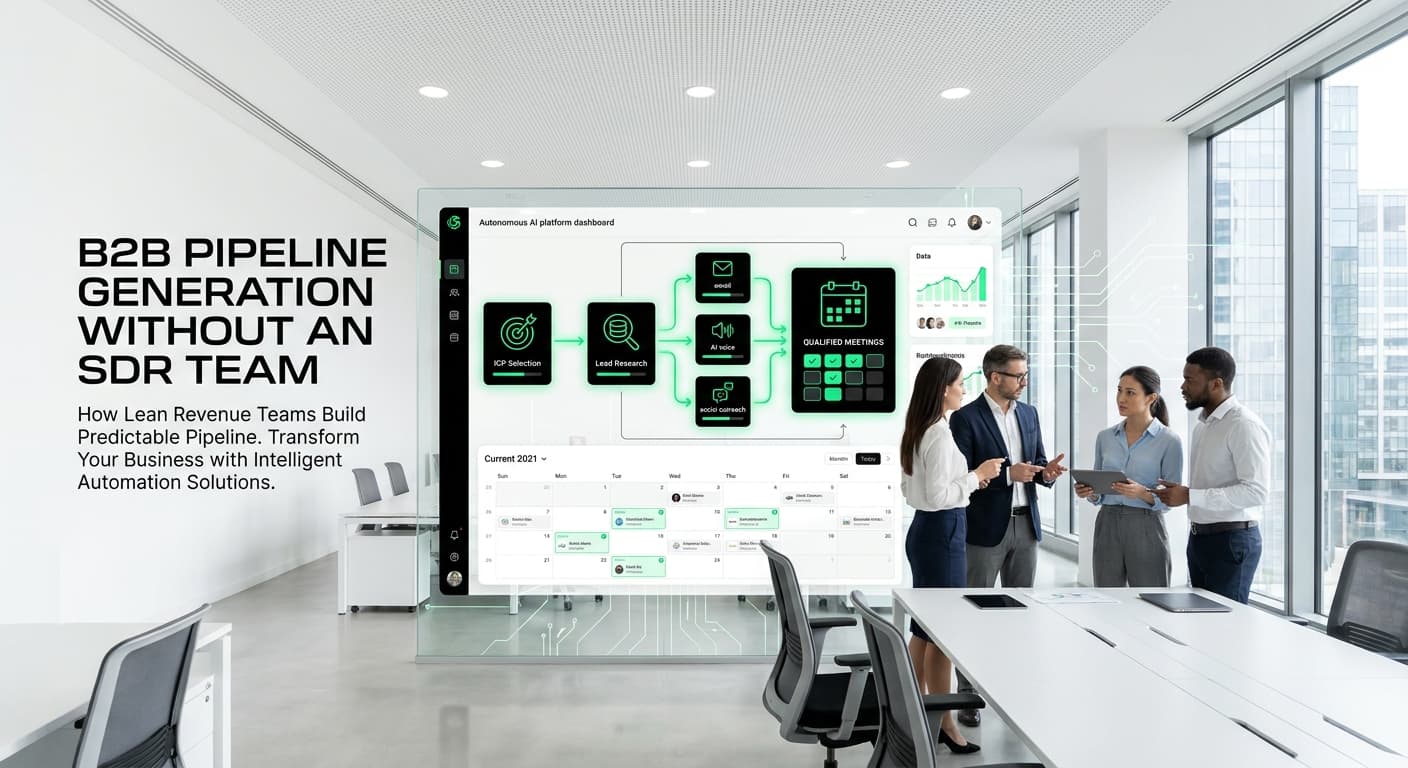
ATLAS by Captivix is one AI system that sells, bids and delivers. For B2B pipeline generation, it builds your ideal customer profile, finds matching buyers, researches each company and person, runs personalized outreach and books qualified meetings on your calendar. Your team approves the outreach before it goes out.
With ATLAS pipeline generation, leads are scored on fit and interest and re-ranked every day as they engage, so your team works the warmest accounts first. Outreach runs across email, SMS, AI voice, LinkedIn and social, with each message written from that buyer's research rather than a template. AI voice outreach must follow TCPA consent rules; see AI cold calling rules.
KE Staffing, an IT staffing and executive search firm, used ATLAS to turn relationship-led business development into a repeatable motion. In early results, monthly touchpoints rose from about 3,000 to more than 4,500 and potential meetings rose from 18 to 28. Read the KE Staffing case study.
Frequently asked questions
Can you build a B2B sales pipeline without SDRs?
Yes. A lean team can build B2B pipeline without SDRs by running a repeatable system: a tight ideal customer profile, accounts with a reason to buy now, research before every first touch, multichannel follow up, and tracking held meetings. Software can handle the volume work, while a person on your team approves outreach and runs the sales conversations.
What is the difference between pipeline generation and lead generation?
Lead generation collects contacts and inquiries. Pipeline generation turns the right accounts into qualified opportunities your team can close. Lead generation is measured by the number of names collected. Pipeline generation is measured by held meetings, opportunities created and pipeline coverage against your revenue target.
How many meetings should a lean B2B team aim to book each month?
Work backward from revenue. Divide your quarterly new revenue target by your average deal size to get the deals you need, then divide by your close rate to get opportunities, and by your meeting to opportunity rate to get held meetings. Spread that over three months and add a buffer for no shows.
Do AI SDRs actually work?
Results are mixed. In a July 2026 Belkins survey, 77% of teams using AI for lead generation could not confirm a positive ROI. AI works best on research, drafting and follow up volume, with a person reviewing targeting and messages. Fully autonomous setups tend to book more meetings of lower quality.
What is a good cold email reply rate in 2026?
Instantly's 2026 benchmark puts the average cold email reply rate at 3.43%, with top quartile campaigns at 5.5% and elite senders above 10.7%. If you are above 5% you are outperforming most B2B outbound programs. Below 2% usually points to a targeting, timing or deliverability problem rather than copy alone.
The bottom line
You do not need an SDR team to make B2B pipeline generation predictable. You need a narrow target, a reason to reach out, research that makes every message specific, follow up that does not stop after one try, and an honest count of held meetings. Put those five parts in place and a small team can generate pipeline every week without waiting on a new hire to ramp.
See what your pipeline could look like
Give us your website and we will point ATLAS at your market, then walk you through the accounts it finds and what it would say to them. Twenty minutes, no slides.
Sources
- Bridge Group SDR salary, OTE and ramp benchmarks, via Ainora
- Corporate Visions 2025 research on SDR selling time, via Autobound
- Champify trigger win rates, cited by Salesmotion, via Komo
- Instantly 2026 Cold Email Benchmark, via Autobound and Webtonic
- Laxis, The State of the AI SDR 2026
- Clutch cost per appointment data, via B2B Rocket
- Belkins July 2026 survey, via RevSculpt
- RevOps Co-op Q1 2026 meeting conversion data, via Mean CEO
- Forrester 2026 Buyers' Journey Survey, via Abmatic
- 6sense buyer research, via Product Studio