

How to Respond to RFPs Faster Without Adding Headcount
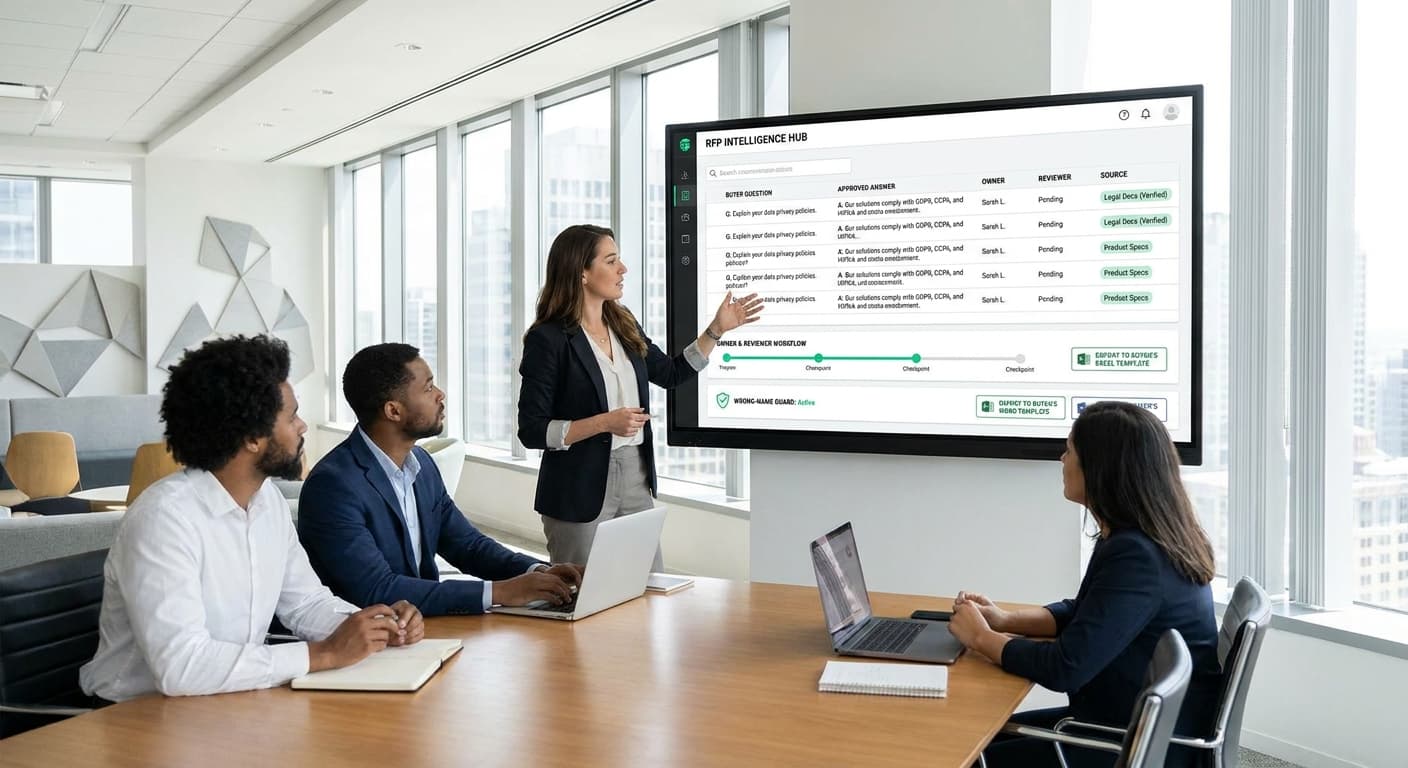
A faster RFP response process starts with three habits: reuse the answers you have already approved, route only the real gaps to experts, and review the riskiest answers first. None of them requires a new hire.
Here is how it usually goes instead. An RFP lands with a ten-day deadline. Most of the questions were answered last quarter, on another bid, but those answers are buried in an old Word file, a shared drive and somebody's inbox. So the sales lead who owns the deal starts retyping, the security engineer gets the same questions again, and the final review happens the night before it is due.
This guide is for teams without a proposal manager, where sales leads and subject matter experts answer RFPs, RFIs and security questionnaires on top of their real jobs. It covers a six-step process, where the hours go and what to measure.
What is an RFP response process?
An RFP response process is the repeatable set of steps your team follows from the moment a request for proposal arrives to the moment you submit. It covers the bid decision, the question list, drafting, expert input, review and submission, and it works the same way for an RFI response or a security questionnaire.
At a large company, a proposal team usually owns this work. At a small or mid-size firm, it belongs to whoever owns the deal, which is why writing the steps down matters more. Without them, every RFP restarts from zero and depends on who remembers where last year's answers live.
The workload is not small. In Loopio's 2026 benchmark, small business teams average four people, submit 79 RFPs a year and spend 27 hours on each. That is about 2,100 hours a year, roughly one full-time job that nobody was hired to do.
A defined process makes RFP response for small business teams predictable. Experts know when they will be asked and for what, the deal owner knows what done looks like, and each RFP leaves the library better than it found it.
Why RFP responses take so long
RFP responses take long because the work is scattered, not because the questions are hard. Most hours go to finding past answers, waiting on experts, copying text into the buyer's template and fixing problems at the last minute. Loopio's 2026 benchmark puts the average at 33 hours of work per RFP.
The same report puts the average team at 166 RFPs a year, up from 153, with nine contributors on each one. At 33 hours apiece, that is about 5,500 hours of RFP work a year.
Capacity has not kept up. In the March 2026 release of Loopio's survey of 1,533 response management professionals, 50% of respondents ranked bandwidth as a top challenge, pushing it past subject matter expert collaboration as the number one challenge for the first time in five years. Four time sinks eat most of those hours:
- Finding past answers. The answer exists, but it sits in an old proposal, a shared drive or an inbox, and the current version looks just like the outdated one.
- Chasing subject matter experts. The same security, legal and product people get pulled into every bid, often for questions they answered last month.
- Retyping into the buyer's template. Buyers send their own Excel or Word file, so answers get copied cell by cell and formatting breaks.
- Last-minute review. Review starts the night before the deadline, so risky answers get the same rushed read as boilerplate.
The 6-step RFP response process for small teams
Here is how to respond to an RFP when nobody's full-time job is proposals: decide fast whether to bid, turn the document into a question list with owners, answer from approved content first, send experts only the gaps, review by risk, and hand back the buyer's own file. Each step works for a two-person team.
1. Decide whether to bid
The fastest RFP is the one you decline early. Before anyone opens the question list, make the bid/no bid decision on fit, relationship, competition, deal size and whether you meet every mandatory requirement. A simple bid/no bid scorecard keeps that to one short meeting.
Most teams have some version of this, but it is slipping. Loopio's 2026 data shows 75% of teams use a go/no go process, down eight points from the prior year, compared with 81% of top performers. Teams respond to 55% of the RFPs they receive.
2. Break the RFP into a question list
Turn the document into one list with a row for every question and requirement, keeping the buyer's numbering and section headings. Add columns for owner, due date, status and answer source. This is your compliance matrix, and it doubles as your final check that nothing was missed. Set internal due dates a few days before the buyer's deadline.
3. Answer from your approved library first
Fill every question you have answered before, using the exact wording that was approved. Search by meaning, not just keywords, because buyers phrase the same question in different ways. Mark each answer with its source so a reviewer knows what to trust.
Do not reword an approved answer just to make it feel fresh. Rewording adds review time and creates a version nobody signed off on. Save your tailoring for the executive summary and the answers that speak to this buyer's concerns.
4. Send only the gaps to subject matter experts
Whatever the library cannot cover goes to an expert, and only that. Send each expert a short list of specific questions in the buyer's wording, with a due date and any close past answer. Experts respond faster to five precise questions than to a 60-page document, and every answer they give becomes a candidate for the library.
5. Review the riskiest answers first
Not every answer carries the same risk. Pricing, legal terms, security and compliance claims, service levels and anything naming a customer deserve the first and closest read. Company history boilerplate can wait.
Check every answer for outdated facts and for another customer's name left over from a past bid. Give each response one owner and one reviewer, and do not submit until every question is settled.
6. Submit in the buyer's format, then save new answers back to the library
Return the buyer's own file whenever they provide one, because evaluators score against their template. If they ask for a narrative document, mirror their section order. After you submit, save every new or improved answer to the library while the context is fresh. That habit is what makes the next RFP faster than this one.
Where RFP response time goes, and how to cut it
Most RFP response time goes to six tasks, and most of them involve no new writing at all. The table below shows why each task drags on a small-team bid and the specific change that cuts it. Start with the first two rows, because that is where repeat work piles up fastest.
| Task | Why it is slow | How to cut it |
|---|---|---|
| Finding past answers | Answers sit in old proposals, shared drives and inboxes, with no clear current version | Keep one approved answer library, searchable by meaning, with a source and owner on every answer |
| Rewording the same answer again | Each writer rephrases, creating unapproved versions that need fresh review | Reuse approved wording as is; tailor only the executive summary and buyer-specific answers |
| Chasing experts | Experts get the whole document or vague requests on top of their real jobs | Send only library gaps, as specific questions with due dates |
| Retyping into the buyer's template | Answers are copied cell by cell into the buyer's Excel or Word file and formatting breaks | Fill the buyer's own file directly, keeping their order and headings |
| Checking for outdated or wrong-customer details | Old facts and other customers' names hide in reused text | Flag any answer that names another customer and record when each answer was last checked |
| Final review | Everything gets the same rushed read the night before the deadline | Grade answers by risk, review the riskiest first, and set an internal deadline days ahead |
RFP automation: what AI should and shouldn't do
RFP automation should find, match and fill answers your team already approved, then hand anything uncertain to a person. It should not invent answers to questions your library cannot cover. A fast answer you cannot stand behind is worse than a blank one, because the buyer will hold you to it.
AI use is already common. Loopio's 2026 research found 79% of teams have used generative AI for RFP responses, up from 68% the year before. General tools such as ChatGPT and Gemini remain the most popular, while 43% of teams now use AI-driven RFP software, up from 33%.
Accuracy is the main worry. In Responsive's 2026 State of Strategic Response Management survey of more than 1,100 decision makers and practitioners, 49% flagged hallucinations and errors as a barrier, the most cited issue.
The risk is not theoretical. In October 2025, the Associated Press reported that Deloitte Australia would partially refund the Australian government for an A$440,000 report containing a fabricated quote from a federal court judgment and references to nonexistent research. That was a consulting report, not an RFP, but an RFP answer is a commitment in the same way.
So keep the job narrow: fill what your team already approved, show where each answer came from, and leave the rest blank for a person. If your team already pastes questions into general tools, read our guide to using ChatGPT for RFPs before the next deadline.
Faster isn't the goal. Winning is.
Speed only matters if it turns into wins. Loopio's 2026 data shows teams are submitting more RFPs while winning a smaller share, and its winning teams spend slightly more time per bid, not less. The point of a faster RFP response process is to free hours for the parts of a proposal that persuade buyers.
In that benchmark, teams won 39% of their RFPs, below the 45% average across Loopio's data from 2019 to 2026. North American teams won 37%, while UK teams led at 47%. The share of bids reaching the shortlist fell to 46%, from 54% the year before.
The stakes are rising too. In Loopio's report announcement, CEO Zak Hemraj said RFPs influence 40% of company revenue, and the company described RFP revenue influence as the highest in five years.
Ownership matters. AutoRFP.ai's 2026 Proposal Win Rate Report, a vendor survey of 94 bid and proposal professionals, found every team with a win rate of 51% or higher had at least one dedicated bid manager, while 56% of low-win teams ran bids as a shared sales or marketing task. The sample is small and the link is a correlation, but the lesson holds: someone has to own each bid, even part time.
Spend the hours you save on a tailored executive summary, direct answers to the concerns this buyer raised, and fewer bids on RFPs you were never likely to win. Our RFP win rate benchmarks post shows how to read these numbers for your own team.
If RFPs are carrying your pipeline because outbound is thin, read our guide to building pipeline without an SDR team. A steadier pipeline makes it easier to say no to poor-fit bids.
What to measure
Track five numbers: RFP response time in working hours, the share of questions answered from your library, expert hours per response, win rate and advancement rate. The first three tell you whether the process is getting faster. The last two tell you whether the time you saved is turning into revenue.
Measure response time in working hours, not calendar days. A rising share of library answers means your library is growing, and falling expert hours mean you are protecting your subject matter experts instead of burning them out.
Advancement rate, the share of bids that reach the shortlist, moves faster than win rate and shows whether evaluators like what they read. Loopio found 95% of teams track success metrics, but most stop at win rate and volume, while top performers also track completion speed and revenue influence.
How ATLAS RFP Response speeds up the RFP response process
ATLAS RFP Response is built on one rule: an answer goes out only if your team has approved it. It fills every question your library covers in your exact approved words, leaves the rest blank for a person, and never invents an answer.
Your team loads past RFP responses (Excel, Word or PDF) into ATLAS Mind, which becomes the approved answer library. Old files need no reformatting. Upload the buyer's RFP as PDF, Word, Excel, CSV or pasted text, up to 25 MB, and ATLAS lays out every question in the buyer's order and section headings.
One click fills every covered question, labeled with its source document and author. Search by meaning finds approved answers even when the buyer words a question differently, and a wrong-name guard holds any answer that names a different customer until someone edits it.
Every response has an owner and a reviewer, answers are graded so the riskiest are reviewed first, and nothing exports until every question is settled. You get back the buyer's own Excel or Word file with only the answer cells filled in, or a branded PDF or Word response. New approved answers save to the library in one click.
Frequently asked questions
These are common questions from small B2B teams setting up an RFP process for the first time. Each answer is short enough to share with a sales lead or subject matter expert who has been pulled into an RFP and wants to know what is expected of them.
How long should an RFP response take?
Loopio's 2026 benchmark puts the average at 33 hours of work per RFP, and 27 hours for small business teams. Calendar time depends on the buyer's deadline. If most answers come from an approved library, those hours move away from searching and retyping and toward tailoring the response and reviewing it.
What are the steps in the RFP response process?
Six steps cover most bids: decide whether to bid, break the RFP into a question list with owners and due dates, answer from your approved library first, send only the gaps to subject matter experts, review the riskiest answers first, and submit in the buyer's format before saving new answers back to the library.
How can a small business respond to RFPs without a proposal team?
Give every RFP one named owner, even if it is the sales lead. Keep approved answers in one searchable library, bid only on RFPs you can win, and ask experts only the questions the library cannot answer. That keeps a part-time effort from turning into a full-time scramble for the same few people.
Can AI answer RFP questions accurately?
Only when it works from content your team has already approved, and only with a person checking the result. General AI tools can produce confident answers that are wrong. In Responsive's 2026 survey, 49% of respondents named hallucinations and errors as a barrier to AI. Treat any unsourced answer as a draft, not a fact.
What is an RFP answer library?
An RFP answer library is a single, searchable collection of answers your team has already approved, usually built from past RFPs, security questionnaires and RFIs. Each answer should show where it came from, who owns it, and when it was last checked, so anyone answering a new RFP can reuse it with confidence.
The bottom line
You do not need a proposal manager to respond to RFPs faster. You need one place for approved answers, a rule that experts only see real gaps, and a review that starts with the riskiest answers. Bid on fewer, better-fit RFPs, and spend the hours you save on the parts of the proposal that win.
Bring us your last RFP
We will show you the next one answered in your team's words, in the buyer's own file.
Sources
- Loopio, "Average RFP Win Rates and More: 38 Proposal Statistics to Know in 2026" (2026 RFP Response Trends and Benchmarks data), March 26, 2026: loopio.com
- Loopio via Business Wire, "New Loopio Research Finds AI Adoption and Leadership Expectations Are Climbing as RFP Revenue Influence Reaches a Five-Year High," March 11, 2026: businesswire.com
- Loopio, "AI and the Future of Proposal Management: A Look at Industry Trends," April 14, 2026: loopio.com
- Responsive, 2026 State of Strategic Response Management Report data, September 15, 2026: responsive.io
- AutoRFP.ai, "When to Hire a Bid Manager: Win Rates, Signals and ROI (2026 Guide)," updated July 24, 2026: autorfp.ai
- Associated Press via CTV News, "Deloitte to partially refund Australian government for report with apparent AI-generated errors," October 7, 2025: ctvnews.ca