What Is a Good RFP Win Rate in 2026? What Winning Teams Do Differently
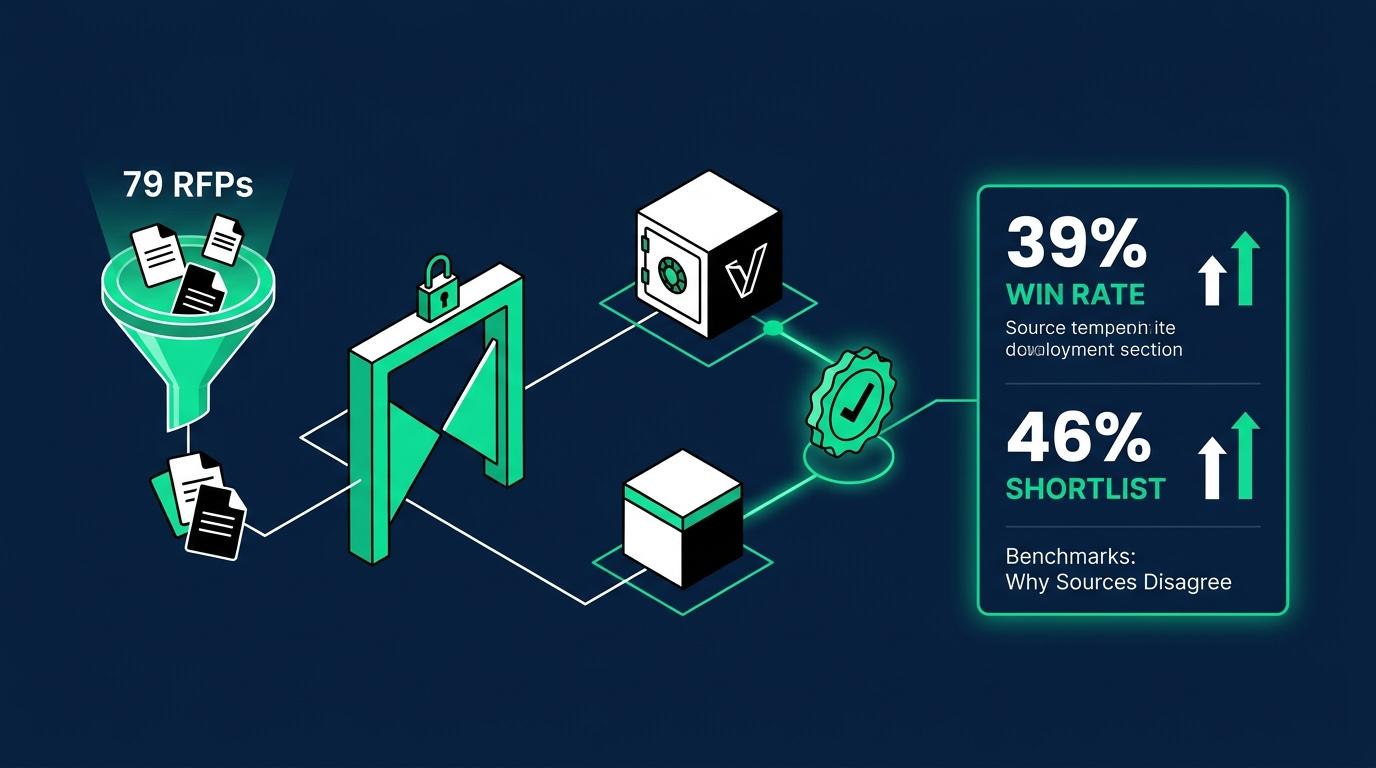
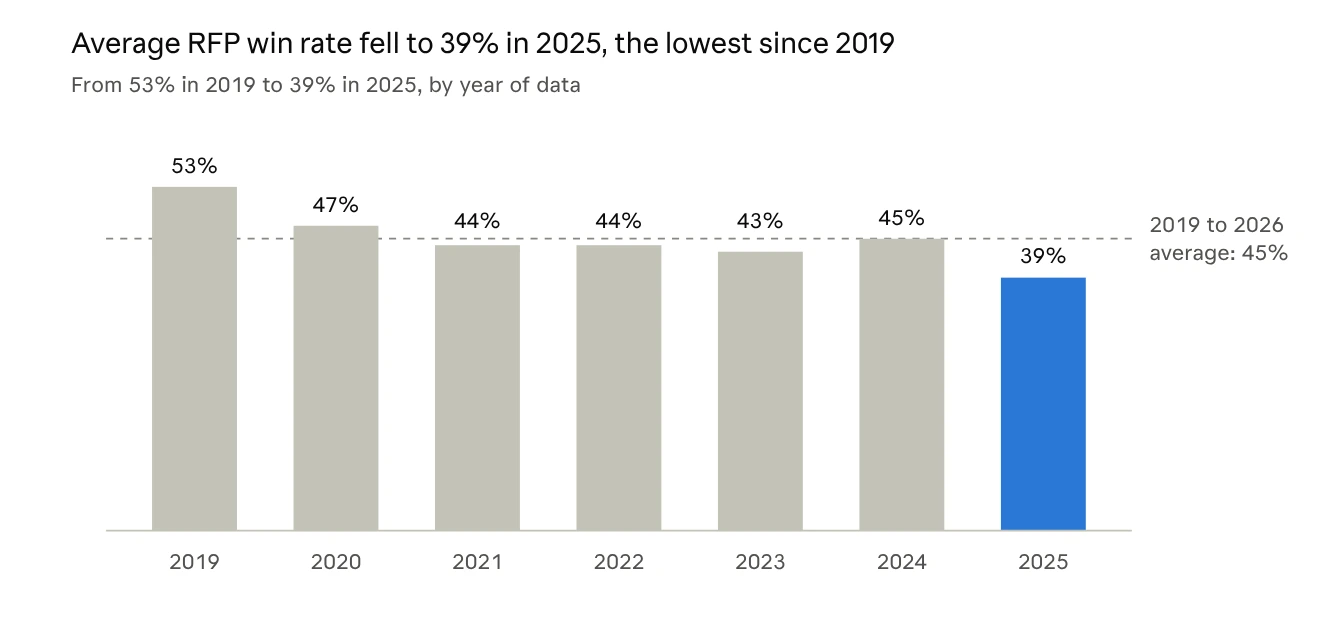
Quick answer: A good RFP win rate in 2026 is 45% or higher. Loopio's 2026 benchmark of 1,533 response professionals, run with APMP, puts the average at 39%, down from 45% the year before, and at 45% across all of its data from 2019 to 2026. North American teams average 37%. Teams that win more than half their bids qualify harder, name one owner per response, and reuse approved answers.
A sales lead hears that "45% is average," checks it against the team's own number, and still doesn't know whether that is good or bad. Another site says 25%. A third says 30 to 50%. Every source quotes a different figure, and almost none explains why.
This guide fixes that. It gives the 2026 RFP win rate benchmarks with their sources and years, explains why the numbers conflict, shows how to calculate your own win rate, and covers what high-win teams do differently. It is written for small and mid-size B2B teams that answer RFPs without a dedicated proposal team. For the response process itself, see our guide on how to respond to RFPs faster without adding headcount.
What is a good RFP win rate in 2026?
A good RFP win rate in 2026 is 45% or higher for most B2B teams, and above 50% puts a team in the top tier. The latest average is 39%, according to Loopio's 2026 report (2025 data), built with APMP from 1,533 respondents. For North American teams, anything above 37% beats the regional average.
| Benchmark | RFP win rate | Source and year |
|---|---|---|
| Average, latest single year | 39% | Loopio 2026 report, 2025 data |
| Average, 2019 to 2026 | 45% | Loopio 2026 report |
| North America | 37% | Loopio 2026 report |
| UK | 47% | Loopio 2026 report |
| Europe | 39% | Loopio 2026 report |
| Advancement (shortlist) rate | 46%, down from 54% | Loopio 2026 report |
| Small business / mid-market / enterprise | 42% / 45% / 47% | Loopio 2025 report, 2024 data |
How to read your number
Use this as Captivix guidance, not a rule. Below 25% usually means the team is bidding on too many poor-fit RFPs. Between 25% and 38% is typical for North American teams in 2026. Between 39% and 45% is at or above the latest average. Between 46% and 50% is strong, and above 50% is top tier. Compare against teams in your region and of your size before setting a target.
Why every site quotes a different RFP win rate
Sources disagree because they measure different things: a single year versus a multi-year average, different report editions, different samples and regions, and different denominators. Loopio's 39% and 45% are both correct. They answer different questions, and many pages quote the older figure as if it were current.
| Number you see | What it actually is | Where it comes from |
|---|---|---|
| 39% | Average win rate in one survey year (2025 data) | Loopio 2026 report |
| 45% | Either the 2019 to 2026 average, or the single-year figure in the 2025 report | Loopio 2026 and 2025 reports |
| 43% | Single year, 2023 data | Loopio 2024 report |
| 53% to 39% | First and last points of Loopio's yearly series | Loopio 2026 report |
| North America 37%, UK 47% | 2026 regional split | Loopio 2026 report |
| 37.9% | Construction firm hit rate, 303 US firms | SMPS Foundation, 2017 |
| 20% to 30% ranges | Sales proposal close rates or opinion ranges | Proposal tools and vendor blogs, often unsourced |
Five things explain most of the gaps:
- Edition labels. Loopio's "2026 report" describes 2025 data. Pages that call 45% the 2026 figure are quoting the older single year or the long-run average.
- Single year versus multi-year. One strong or weak year moves a single-year number far more than a seven-year average.
- Denominator. Some teams divide wins by RFPs submitted, others by RFPs received, qualified bids or contract value. The same performance can look several points better or worse.
- Sample. Loopio surveys proposal professionals, many of whom use RFP software. Smaller vendor surveys can have fewer than 100 respondents.
- Region and segment. UK teams average 47% and North American teams 37%. Construction hard bids, where price decides, run far lower than negotiated B2B services work.
The practical rule: pick one benchmark set, name the year and region, define your denominator, and compare like with like.
How to calculate your RFP win rate
To calculate your RFP win rate, divide the RFPs you won by the RFPs you submitted, then multiply by 100. Leave out bids still awaiting a decision and RFPs the buyer cancelled, and always measure the same 12-month period. Track advancement rate and yield alongside it, because they show where bids are lost.
\text{RFP win rate} = \frac{\text{RFPs won}}{\text{RFPs submitted}} \times 100\text{Advancement rate} = \frac{\text{RFPs shortlisted}}{\text{RFPs submitted}} \times 100\text{Yield} = \frac{\text{RFPs won}}{\text{RFPs received}} \times 100Worked example (illustration): a firm receives 120 RFPs, submits 60, is shortlisted on 27 and wins 21. Its RFP win rate is 35%, its advancement rate is 45%, and its yield is 17.5%.
Advancement rate
Advancement rate, also called shortlist rate, is the share of submitted RFPs that reach the next round, such as a presentation or best and final offer. It moves faster than win rate and shows whether evaluators like what they read. Loopio's 2026 report puts the average at 46%, down from 54% the year before.
Qualified win rate and yield
Qualified win rate counts only bids that passed a written go/no-go check, so it shows how well you win the bids you chose on purpose. Yield shows how much of your incoming demand turns into revenue. At Loopio's averages, teams answer 55% of the RFPs they receive and win 39% of those, which means only about 21% of RFPs received become wins (Captivix calculation).
Dollar win rate
Counting wins treats a $20,000 bid and a $2 million bid the same. Dollar win rate divides contract value won by contract value bid. In the SMPS Foundation's study of 303 US architecture, engineering and construction firms, 92% tracked hit rate by count, and fewer than 40% tracked it by dollar value.
RFP win rates by region, company size and industry
RFP win rates vary widely by segment. In Loopio's 2026 report, UK teams averaged 47% while North American teams averaged 37%. In the 2025 report, enterprise teams won 47% against 42% for small businesses. Construction hit rates run lower still, so compare yourself with teams like yours.
North America versus the UK and Europe
Loopio's 2026 data puts the UK at 47%, Europe at 39% and North America at 37%. A US or Canadian team at 40% is above its regional average, even though it sits below the long-run global figure of 45%.
Small business versus enterprise
In Loopio's 2025 report (2024 data), enterprise teams won 47%, mid-market 45% and small businesses 42%. Loopio's 2026 report shows why: enterprise teams spend 39 hours per RFP against 27 for small business teams, and Loopio notes they "boast higher win rates because of it."
Construction and engineering
Construction usually talks about bid hit rate rather than RFP win rate. The SMPS Foundation's survey of 303 US AEC firms, reported in 2017, found construction firms averaged a 37.9% hit rate, against 44.2% for engineering firms. Public hard-bid work, where price decides, runs much lower, so track negotiated and hard-bid work separately. More on this for contractors.
Why RFP win rates fell in 2026
RFP win rates fell because teams are bidding on more RFPs with the same people. Loopio's 2026 report shows submissions up from 153 to 166 a year, go/no-go use down 8 points to 75%, and bandwidth ranked the top challenge for the first time in five years. More bids per person leaves less time to tailor each one.
The pressure shows up across the funnel. Teams now answer 55% of the RFPs they receive, and the shortlist rate fell from 54% to 46%. Price remains the top reason teams give for losing, and only 13% blame the quality of their own proposal, according to Loopio's 2026 data.
The stakes are high. In Loopio's report announcement, the company said RFPs influence about 40% of revenue, a five-year high. A falling RFP win rate is a revenue problem, not just a proposal team problem.
What winning teams do differently
High-win teams bid on fewer, better-fit RFPs, give every response one owner, decide their win themes before writing, reuse approved answers, and spend the time they save on tailoring. Most of the data below comes from vendor surveys with small samples, so read it as a pattern, not proof of cause.
Two sources inform this section. Loopio's 2026 report covers 1,533 respondents. AutoRFP.ai's 2026 Proposal Win Rate Report, run with Stargazy, is a vendor survey of about 90 bid professionals that compares high-win teams (51% or higher) with low-win teams.
They bid on fewer, better-fit RFPs
In Loopio's 2026 data, 81% of top performers use a go/no-go process, against 75% of all teams, a figure that fell 8 points in a year. Saying no early is the fastest way to protect expert hours for the bids you can win.
Before accepting an RFP, ask three questions. Is this a real fit for what you sell today? Have you won similar work in the last 12 to 24 months? Can you answer it from approved content without stretching your claims? If two of the three answers are weak, the bid is usually a distraction.
Someone owns every bid
In AutoRFP.ai's survey, every team with a win rate of 51% or higher had at least one dedicated bid manager (AutoRFP.ai). A small team does not need a new hire to get that effect. It needs one named owner and one reviewer on every response.
They decide their win themes before writing
A win theme is the short, specific reason this buyer should choose you, repeated through the response. AutoRFP.ai found 71% of high-win teams use defined win themes, against 42% of low-win teams, and teams with win themes averaged a 37% win rate against 29% without.
They answer from an approved library
In the same survey, 59% of high-win teams used content library automation, against 36% of low-win teams. Reusing approved answers keeps compliance wording consistent and stops old client names from slipping into new bids.
They spend more time per bid, not less
Winning teams in Loopio's 2026 report spent 35 hours per submission, against the 33-hour average. The point of reusing answers is not to finish faster. It is to move hours from searching and retyping into tailoring the executive summary and the answers that address this buyer's concerns.
They get in before the RFP is issued
In Responsive's July 2025 survey of 350 B2B buyers, 61% said they started an RFP already leaning toward one vendor. Relationships built before the RFP arrives often decide it. That is why steady outbound matters, covered in our guide on building pipeline before the RFP is issued.
They track more than win rate
Loopio found 95% of teams track success metrics, but top teams look past win rate to advancement rate, completion speed and revenue influenced. Ask every buyer you lose to for a debrief, and record the loss reason in the same place every time.
What losing bids cost a small team
A low RFP win rate costs hours, not just deals. Loopio's 2026 report puts the average small business team at four people, 79 RFPs a year and 27 hours per RFP, about 2,100 hours in total. At a 39% win rate, about 48 of those bids lose, so roughly 1,300 hours a year go to bids that never pay off.
Hours spent on losing bids, Captivix calculation from Loopio 2026 inputs
| Team profile | RFPs a year | Hours per RFP | Total hours | Win rate | Losing bids | Hours on losing bids |
|---|---|---|---|---|---|---|
| Small business team | 79 | 27 | 2,133 | 39% | about 48 | about 1,300 |
| Small business team, 2025 small business rate | 79 | 27 | 2,133 | 42% | about 46 | about 1,240 |
| Average team | 166 | 33 | 5,478 | 39% | about 101 | about 3,340 |
Loopio's public 2026 material does not give a small business win rate, so the first row uses the all-team average. The upside is real: moving from 39% to 44% on the same 79 bids adds about four wins a year with no extra hours. Those hours are also capacity a lean team cannot easily replace, as our breakdown of what a full-time SDR really costs in 2026 shows for sales roles.
Where does your team stand? A self-assessment
Score your team on the signals below, then find the profile that fits. Most small teams sit in the first two rows, and the fastest gains come from bid selection and an approved answer library, not from writing faster.
RFP win rate self-assessment, Captivix guidance based on Loopio 2026 data
| Signal | Needs work | At benchmark | Top performer |
|---|---|---|---|
| RFP win rate | Under 30% | 37% to 45% | Over 50% |
| Advancement rate | Under 38% | About 46% | Over 60% |
| Share of received RFPs answered | Over 80% | About 55% | Lower, with a reason for each no |
| Written go/no-go | None | Sometimes | Every RFP |
| Owner per response | Whoever is free | Big bids only | Owner and reviewer on every bid |
| Win themes | None | Big bids only | Decided before writing |
| Approved answer library | Old files and email | Shared folder | Maintained library with owners |
| Loss reasons | Never tracked | Sometimes | Every loss, with a debrief request |
| Team profile | Typical symptoms | What it means for win rate | Best next move |
|---|---|---|---|
| Reactive | Answers most RFPs, uses old files, reviews late | Win rate is held down by poor fit and inconsistent content | Add a written go/no-go and centralize approved answers |
| Busy but organized | Has a library but still hunts for answers | Win rate may hold, but effort per bid is too high | Improve retrieval and review routing |
| Selective | Declines poor-fit bids and reuses approved wording | Win rate rises because the bid mix is stronger | Formalize selection criteria and keep the library current |
| High win | Narrow bid list, consistent answers, controlled review | Win rate is driven by fit, not just effort | Add volume carefully and protect review time |
Can AI improve your RFP win rate?
AI does not raise RFP win rates on its own. AutoRFP.ai's 2026 survey found no correlation between AI adoption and win rate once process factors were included. AI helps when it frees hours for qualification, win themes and review. It hurts when it produces generic or invented answers that evaluators notice.
Do not confuse response speed with response quality. A faster draft that includes another client's name, outdated compliance wording or an unapproved claim does more harm than a slower, accurate one. The goal is controlled execution: answer from approved content, flag the gaps, and submit only what your team is prepared to stand behind.
How ATLAS RFP Response fits
ATLAS RFP Response is built for the reuse step, so your experts can spend their hours on fit and tailoring. Your team loads past RFP responses into ATLAS Mind, which becomes your approved answer library. One click fills every question the library covers, in your team's exact approved words, with the source document and author shown.
Questions without a strong match stay blank for a person to write, so ATLAS never invents an answer. A wrong-name guard holds any answer that names a different client until someone edits it. Every response has an owner and a reviewer, the riskiest answers are reviewed first, and you get back the buyer's own Excel or Word file with only the answer cells filled in. ATLAS RFP Response works on question-and-answer RFPs, not narrative sections or resumes.
Frequently asked questions
What is the average RFP win rate in 2026?
The average RFP win rate is 39%, according to Loopio's 2026 RFP Response Trends and Benchmarks Report, a survey of 1,533 response professionals run with APMP. That is down from 45% a year earlier. Across all of Loopio's data from 2019 to 2026, the average is 45%. North American teams average 37%.
What is a good RFP win rate?
For most B2B teams, a good RFP win rate is 45% or higher, which matches Loopio's 2019 to 2026 average. Above 50% puts you among top performers. Below 25% usually means you are bidding on too many poor-fit opportunities. Compare against your region and company size before setting a target.
How do you calculate RFP win rate?
Divide the number of RFPs you won by the number you submitted, then multiply by 100. If you submitted 40 RFPs and won 14, your win rate is 35%. Leave out bids still awaiting a decision and RFPs the buyer cancelled, and measure the same 12-month period each time.
What is an RFP advancement rate?
Advancement rate, also called shortlist rate, is the share of submitted RFPs that move to the next round, such as a presentation or best and final offer. Loopio's 2026 report puts the average at 46%, down from 54%. A low advancement rate usually points to fit or compliance problems rather than price.
Why are RFP win rates falling?
Teams are bidding on more RFPs with the same people. Loopio's 2026 data shows submissions up from 153 to 166 a year, go/no-go use down 8 points to 75%, and bandwidth ranked the top challenge for the first time in five years. More bids per person leaves less time to tailor each one.
What is a good bid win rate in construction?
Construction hit rates run lower than most RFP markets. The SMPS Foundation's survey of 303 US architecture, engineering and construction firms found construction firms averaged a 37.9% hit rate, against 44.2% for engineering firms. Public hard-bid work, where price decides, is commonly much lower, so track negotiated and hard-bid work separately.
How can a small team improve its RFP win rate?
Bid on fewer, better-fit RFPs, give every response one named owner, and reuse approved answers so time goes into tailoring. In AutoRFP.ai's 2026 vendor survey, every team winning more than half its bids had a dedicated bid manager, and 71% used defined win themes, against 42% of low-win teams.
Does AI improve RFP win rates?
Not by itself. AutoRFP.ai's 2026 Proposal Win Rate Report found no correlation between AI adoption and win rate once process factors were included. AI helps when it frees hours for qualification, win themes and review. It hurts when it produces generic or invented answers that evaluators notice.
The bottom line
A good RFP win rate in 2026 is 45% or higher, the latest average is 39%, and North American teams sit at 37%. The teams that beat those numbers do not answer faster. They bid on fewer, better-fit RFPs, name an owner for every response, and reuse approved answers so their experts can tailor what matters.
Bring us your last RFP
We will show you the next one answered in your team's words, in the buyer's own file, so your experts spend their hours on the bids you can win.
Sources
Figures were checked in November 2026. Captivix calculations combine these figures with the formulas shown. Loopio, AutoRFP.ai and Responsive sell RFP software, so their findings are labeled as vendor research.
- Loopio, 2026 RFP Response Trends and Benchmarks Report, with APMP, 1,533 respondents (PDF)
- Loopio, 38 Proposal Statistics to Know in 2026 (March 26, 2026)
- Loopio via Business Wire, report announcement (March 11, 2026)
- Loopio, 2025 RFP Response Trends and Benchmarks Report (PDF)
- AutoRFP.ai and Stargazy, 2026 Proposal Win Rate Report statistics (vendor survey)
- AutoRFP.ai, When to Hire a Bid Manager (2026)
- Responsive, What Buyers Really Look for in an RFP (July 2025 survey of 350 B2B buyers)
- SMPS Foundation hit rate study of 303 AEC firms, via Building Design and Construction (2017)