
Staffing Tech Stack in 2026: CRM, Outreach, Scheduling, Analytics, Automation & the AI Execution Layer
The Modern Staffing Tech Stack: Six Core Layers and the Missing Execution Component

Most staffing firms do not have a shortage of tools.
They already have something for client management, outreach, scheduling, reporting, and automation. But even with all of that, the same problems keep showing up:
- Follow-ups slip
- Handoffs break
- Recruiters and sales teams work in silos
- Leadership struggles to get a clear picture of what is happening
That is because the problem is usually not the tools themselves.
The problem is that the tools do not work together in a way that actually helps the business move faster.
In 2026, staffing firms are not just looking for more software. They are looking for a cleaner system. They want something that helps them manage the full workflow — not just one part of it.
That is where the modern staffing tech stack starts to change.
What a Modern Staffing Tech Stack Looks Like
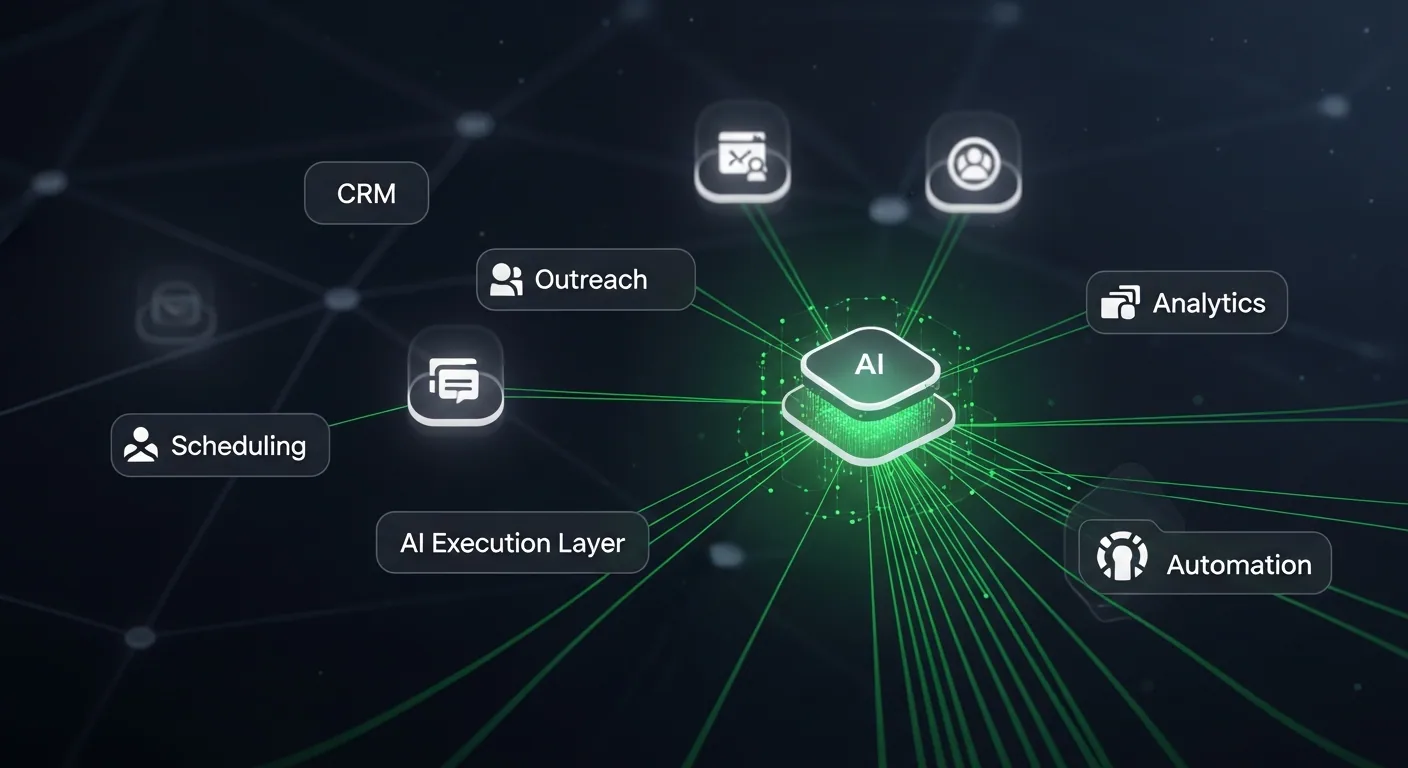
A strong staffing tech stack today usually includes six core layers:
- CRM
- Outreach
- Scheduling
- Analytics
- Automation
- Execution
Each one plays a role. But each one also has limits.
Comparison Table: The 6 Core Layers of a Modern Staffing Tech Stack
| Layer | What it does | Why it matters | Where it usually falls short |
|---|---|---|---|
| CRM | Manages client relationships, deals, and account activity | Keeps sales organized | Often disconnected from recruiting and delivery |
| Outreach | Handles email sequences, follow-ups, and campaigns | Helps teams stay active and consistent | Often becomes another silo |
| Scheduling | Coordinates meetings, interviews, and follow-up calls | Saves time and reduces back-and-forth | Solves only one small part of the workflow |
| Analytics | Shows team performance, pipeline health, and trends | Gives visibility into what is happening | Usually tells you what happened, not what to do next |
| Automation | Connects systems and reduces repetitive work | Helps remove manual tasks | Breaks when workflows get more complex |
| Execution Layer | Runs and coordinates workflows across teams and tools | Keeps the whole process moving | Missing in many staffing firms |
CRM: Good for Tracking, Not Enough for Execution
A CRM helps staffing firms manage clients, opportunities, and account activity. That matters because sales teams need a clear place to track conversations, deals, and pipeline movement.
But CRM alone does not solve the bigger operational problem.
It does not make sure handoffs happen cleanly. It does not make sure follow-ups actually go out on time. It does not make recruiting, sales, and delivery work like one connected system.
CRM is important. But it is only one part of the stack.
Outreach: Useful, But Often Isolated
Outreach tools help teams send messages, run sequences, and stay active with prospects, candidates, and clients.
That sounds great on paper, and it is useful.
But many staffing firms end up with outreach happening in one system, client data in another, recruiting workflows somewhere else, and follow-up context spread across notes, inboxes, and spreadsheets.
So even though outreach is happening, it still feels disconnected from the rest of the business.
That is why some firms are sending more messages without actually improving coordination.
Scheduling: Helpful, But Only One Step
Scheduling tools are great for reducing back-and-forth. They save time and make it easier to book interviews, calls, and meetings.
But staffing firms do not win because scheduling is easier.
They win because the full workflow is tighter.
A scheduling tool can help move one step faster, but it does not fix what happens before or after that step. It does not solve poor handoffs, missed updates, or broken follow-up processes.
Analytics: Visibility Matters, But Reports Alone Are Not Enough
Analytics tools help leadership answer important questions:
- What is happening in the pipeline?
- Where are deals slowing down?
- Which recruiters are overloaded?
- Which clients need more attention?
That visibility matters.
But most analytics tools are still reactive. They help you understand what already happened. They do not necessarily help your team act faster in the moment.
In other words, reports are useful. But reports alone do not move a role forward or keep a workflow from breaking.
Automation: Good for Simple Tasks, Weak for Real Staffing Complexity
Automation tools are often used to connect systems and reduce repetitive work. They can trigger actions, move data, and save time.
That is valuable.
But real staffing workflows are rarely simple.
Sales, recruiting, onboarding, follow-ups, submissions, client communication, and internal coordination all involve exceptions, handoffs, and changes. Simple automations can help at the edges, but they often fall apart when the workflow becomes more human, messy, and dynamic.
That is where many staffing firms realize they need something more than just automation.
They need execution.
The Missing Piece: Execution
This is the part most staffing firms are still missing.
They have tools for storing data, sending messages, booking meetings, and tracking performance.
But they still do not have a real operating layer that helps the full workflow run cleanly from start to finish.
That means:
- Sales follow-up still depends on memory
- Recruiting handoffs still happen through email or notes
- Internal updates still require chasing people
- Leadership still needs meetings just to understand what is going on
The missing layer is not another dashboard.
It is the layer that helps work actually happen.
Where ATLAS Fits
This is where ATLAS comes in.
ATLAS can handle CRM, outreach, scheduling, analytics, automation, and execution workflows. More importantly, it can connect them so the business does not feel like a group of separate tools held together by manual coordination.
That does not mean every staffing firm needs to rip out everything they already use.
Some firms will keep parts of their stack. Some will use ATLAS to replace certain functions. Others will use it as the layer that brings everything together — powered by agentic AI that reasons and adapts instead of following rigid rules.
The point is not to force an all-or-nothing change.
The point is to remove the friction that slows teams down every day.
Comparison Table: Traditional Tool Stack vs ATLAS
| Capability | Traditional Tool Stack | ATLAS |
|---|---|---|
| Manage client activity | Yes | Yes |
| Run outreach and follow-ups | Yes | Yes |
| Handle scheduling | Yes | Yes |
| Provide analytics | Yes | Yes |
| Automate workflows | Yes | Yes |
| Connect all of these in one operating flow | Usually limited | Yes |
| Reduce handoff friction across teams | Usually limited | Yes |
| Act as an execution layer across the business | Rarely | Yes |
Explore the full library of pre-built agents available for staffing workflows, including lead management, follow-up automation, and candidate coordination.
Do You Really Need Separate Tools for Everything?
That depends on how your business runs today.
If your workflow is simple, your team is small, and coordination is not a problem yet, a basic set of tools may be enough.
But once growth starts creating more handoffs, more exceptions, and more internal complexity, the stack starts to show its cracks.
Quick Decision Table
| If your main problem is... | The best fit is usually... |
|---|---|
| You need better client and deal tracking | CRM |
| You need more consistent outbound activity | Outreach tools |
| You waste time scheduling | Scheduling tools |
| You need better reporting and visibility | Analytics |
| You need to reduce repetitive manual tasks | Automation |
| You have too many moving parts, broken handoffs, and poor coordination across teams | ATLAS |
What Staffing Leaders Should Ask Right Now
If you are evaluating your current stack, ask yourself a few simple questions:
- Are follow-ups still falling through the cracks?
- Do sales and recruiting still rely on manual handoffs?
- Are updates scattered across multiple systems?
- Does leadership have real visibility, or are people still asking for updates in meetings?
- Is your team spending more time coordinating work than doing the actual work?
If the answer to several of those is yes, then the issue is probably not a missing tool.
It is a missing execution layer.
See how other staffing firms have tackled this exact problem in our story: The Deal That Should Have Closed (But Didn't).
The Shift Happening in 2026
Staffing firms are moving away from tool-heavy thinking.
The old mindset was: _What tool should we add next?_
The better question now is: _How do we make the whole workflow run better?_
That is the real shift.
The firms that win are not always the ones with the biggest stack. They are the ones that remove friction, reduce manual coordination, and make execution easier across the business.
Whether you are exploring AI services, digital transformation, or a more unified operating system, the direction is the same: connect the work, not just the tools.
Final Thought
A modern staffing tech stack is not just a list of tools.
It is a system.
CRM, outreach, scheduling, analytics, and automation all matter. But without an execution layer, teams still end up doing the hard work of connecting everything manually.
That is where time gets lost. That is where revenue leaks. That is where growth starts to feel heavier than it should.
ATLAS is valuable because it does more than track, report, or automate one step.
It helps the whole workflow move.