

ERP Evaluation Checklist: Streamline Your Selection Process for Maximum Impact
Streamline Your Selection Process for Maximum Impact

Did you know that nearly 60% of ERP implementations exceed their original budget? Selecting an ERP system isn't just another IT purchase—it's like choosing the nerve center of your entire business operations.
A wrong choice can lead to wasted resources, frustrated employees, and missed opportunities. But with the right evaluation framework, you can turn this complex decision into a structured, confident process that sets your organization up for long-term success.
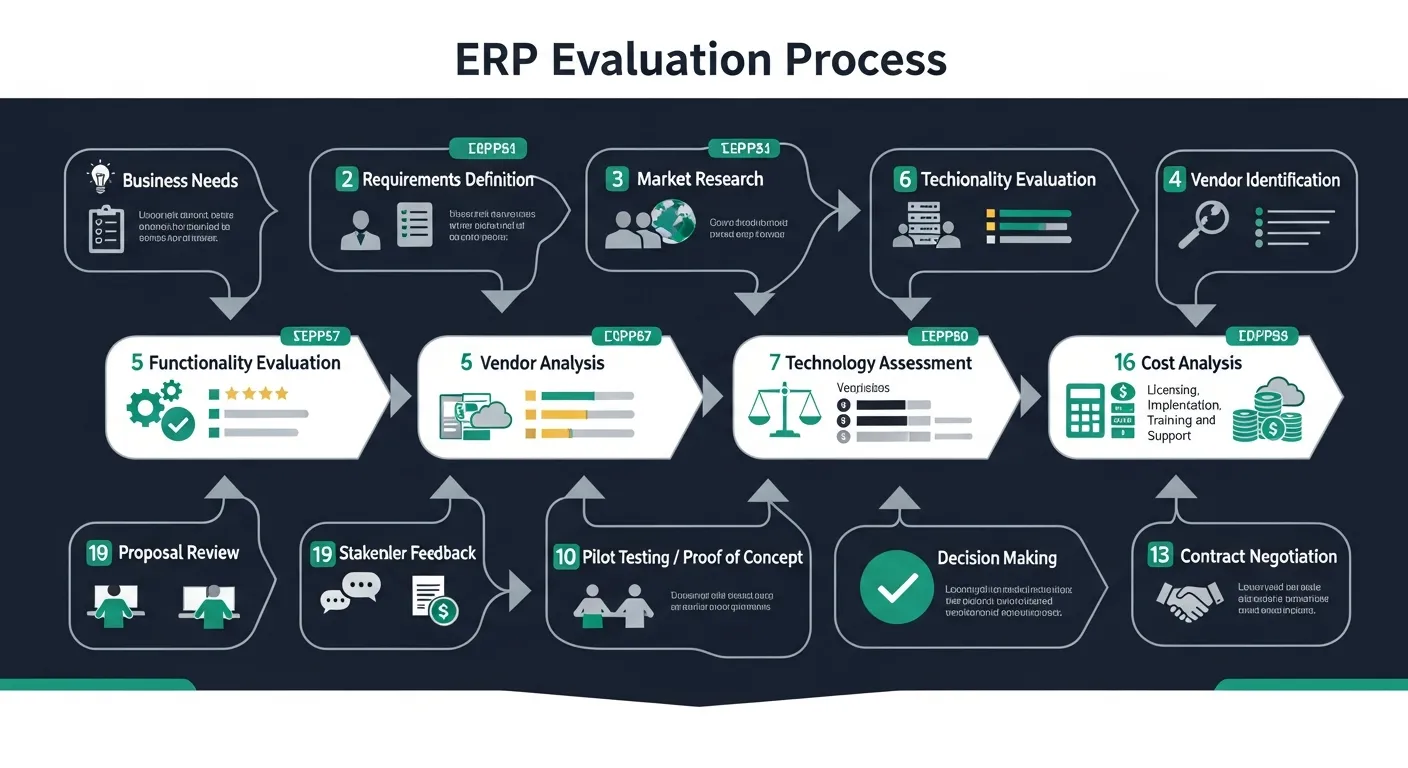
This comprehensive 13-step ERP evaluation checklist will guide you through every critical aspect of the selection process, from understanding your business needs to post-selection planning.
13-Step Checklist for Success
A successful ERP evaluation requires a methodical approach that leaves no stone unturned. Here are the 13 essential steps that will guide your selection process:
- Understanding Your Business Needs
- Evaluating ERP Functionality
- Technical Considerations
- User Experience and Interface
- Vendor Evaluation
- Cost Analysis
- Implementation and Support
- Future-Proofing Your ERP
- Stakeholder Involvement
- Pilot Testing and Evaluation
- Risk Assessment
- Final Decision-Making
- Post-Selection Planning
Let's dive deep into each step to ensure your ERP evaluation covers every critical dimension.
1. Understanding Your Business Needs
Before evaluating any ERP system, you need a crystal-clear understanding of where your organization stands today and where it needs to go. This foundational step shapes every decision that follows.
Assess Current Landscape
- Document all existing business processes, workflows, and pain points across every department
- Identify inefficiencies, bottlenecks, and manual workarounds in your current systems
- Map data flows between departments to understand integration requirements
- Catalog all existing software tools and evaluate which ones the ERP must replace or integrate with
Define Clear Objectives
- Establish specific, measurable goals for the ERP implementation such as reducing order processing time by 30%
- Prioritize objectives into must-have, should-have, and nice-to-have categories
- Align ERP objectives with the broader business strategy and growth plans
- Set realistic timelines and benchmarks to measure the success of the new system
Build Evaluation Team
- Assemble a cross-functional team with representatives from finance, operations, IT, HR, and sales
- Designate a project champion or executive sponsor to drive accountability and decision-making
- Include end-users who will interact with the system daily to provide practical insights
- Consider engaging an independent ERP consultant to provide unbiased expertise
Choose Evaluation Approach
- Decide between a formal RFP (Request for Proposal) process or a more agile evaluation methodology
- Establish clear evaluation criteria and a standardized scoring system before engaging vendors
- Define the evaluation timeline with key milestones and decision points
- Create a communication plan to keep all stakeholders informed throughout the process
2. Evaluating ERP Functionality
The heart of any ERP system lies in its functionality. You need to ensure the solution covers your core business processes while offering room for growth and specialization.
Core Modules
- Finance & Accounting: General ledger, accounts payable/receivable, budgeting, financial reporting, and multi-currency support
- Human Resources: Payroll processing, benefits administration, talent management, time tracking, and compliance management
- Supply Chain Management: Procurement, inventory management, warehouse operations, demand planning, and logistics coordination
- Customer Relationship Management: Sales pipeline management, customer service, marketing automation, and customer analytics
- Manufacturing: Production planning, shop floor control, quality management, bill of materials, and capacity planning
- Project Management: Resource allocation, project tracking, budget management, time and expense reporting, and milestone tracking
Additional Features
- Advanced business intelligence and analytics with customizable dashboards and real-time reporting
- Document management and workflow automation for streamlined approvals and record keeping
- E-commerce integration capabilities for seamless online sales channel management
- Multi-company and multi-site management for organizations with complex corporate structures
- Advanced planning and scheduling tools for optimizing resource utilization
- Built-in compliance and regulatory reporting features to reduce audit preparation time
Industry-Specific Functionality
- Evaluate whether the ERP offers pre-built industry templates and best practices for your sector
- Check for industry-specific compliance features such as FDA regulations for manufacturing or GAAP for finance
- Assess the vendor's track record and customer base within your industry vertical
- Determine if industry-specific modules are native to the platform or require third-party add-ons
Customization Capabilities
- Evaluate the platform's low-code or no-code customization tools for business user modifications
- Understand the impact of customizations on future upgrades and system maintenance
- Assess the availability of a robust API framework for custom integrations and extensions
- Determine the balance between out-of-the-box functionality and customization to minimize complexity
3. Technical Considerations
The technical architecture of your ERP system will determine its performance, reliability, and long-term viability. Make sure the technology aligns with your IT strategy.
Deployment Options
- Cloud (SaaS): Lower upfront costs, automatic updates, scalability on demand, and reduced IT infrastructure burden
- On-Premises: Full data control, customization freedom, one-time licensing, and compliance with strict data sovereignty requirements
- Hybrid: Combines cloud flexibility with on-premises control for sensitive data, offering a balanced approach for complex requirements
- Evaluate total cost implications, security requirements, and performance needs for each deployment model before deciding
Integration Capabilities
- Assess native integration options with your existing technology stack including CRM, e-commerce, and productivity tools
- Evaluate the robustness of the API framework including REST, SOAP, and webhook support
- Check for pre-built connectors to popular business applications and third-party services
- Understand the middleware requirements and data mapping capabilities for complex integrations
Mobile Accessibility
- Evaluate the quality and functionality of native mobile applications for iOS and Android
- Test the responsive design of the web interface across different devices and screen sizes
- Assess offline capabilities for field workers and employees in areas with limited connectivity
- Review mobile security features including biometric authentication and remote data wiping
Security Features
- Verify compliance with industry security standards such as SOC 2, ISO 27001, and GDPR
- Evaluate role-based access controls, data encryption at rest and in transit, and audit trail capabilities
- Assess disaster recovery procedures, backup frequency, and guaranteed recovery time objectives
- Review the vendor's security incident response process and historical track record on data protection
4. User Experience and Interface
A powerful ERP system is only as good as its usability. If your team can't navigate it efficiently, even the most feature-rich platform will fall short of expectations.
- Evaluate the intuitiveness of the user interface including navigation, menu structure, and overall design consistency
- Assess the learning curve for new users and the availability of in-app guidance, tooltips, and contextual help
- Check for personalization options that allow users to customize dashboards, views, and workflows to their roles
- Test the search functionality and how quickly users can find information across the system
- Consider how the interface supports different user skill levels from power users to occasional users
- Evaluate the quality of built-in training materials, video tutorials, and interactive walkthroughs
- Assess the platform's support for multiple languages and regional formatting requirements
- Review change management tools that help drive user adoption and minimize resistance
- Verify compliance with accessibility standards such as WCAG 2.1 for users with disabilities
- Test screen reader compatibility, keyboard navigation, and high-contrast display options
- Evaluate font sizing options, color-blind friendly design elements, and voice command support
- Assess the availability of accessibility documentation and vendor commitment to inclusive design
- Review the depth and flexibility of built-in reporting and analytics tools
- Evaluate the ability to create custom reports, ad-hoc queries, and automated report scheduling
- Check for real-time dashboard capabilities with drill-down functionality and data visualization options
- Assess integration with third-party business intelligence platforms for advanced analytics needs
5. Vendor Evaluation
Your ERP vendor becomes a long-term business partner. Choosing the right vendor is just as important as choosing the right software.
- Research the vendor's financial stability, market position, and years of experience in the ERP industry
- Evaluate the vendor's customer retention rate and overall market reputation through independent reviews
- Assess the size and expertise of the vendor's development team and their investment in R&D
- Check for industry analyst ratings and recognition from firms like Gartner, Forrester, and IDC
- Evaluate the availability and quality of customer support channels including phone, email, chat, and self-service portals
- Understand service level agreements (SLAs) for response times, issue resolution, and system uptime guarantees
- Assess the vendor's global support coverage and availability of support in your time zones and languages
- Review the vendor's escalation procedures and how they handle critical issues and emergency situations
- Understand the vendor's implementation methodology and whether it aligns with your project management approach
- Evaluate the quality and experience of the vendor's implementation consultants and project managers
- Assess the vendor's partner ecosystem and certified implementation partners in your region
- Review typical implementation timelines and success rates for organizations of similar size and complexity
- Request and contact customer references from organizations in your industry and of similar size
- Ask for detailed case studies that demonstrate measurable ROI and business impact
- Attend user group meetings or conferences to hear unfiltered feedback from existing customers
- Conduct independent research through online forums, review sites, and industry publications
6. Cost Analysis
Understanding the true cost of an ERP system goes far beyond the sticker price. A thorough cost analysis prevents budget surprises and ensures a positive return on investment.
- Calculate all licensing costs including per-user fees, module costs, and any tiered pricing structures
- Factor in infrastructure costs for hardware, hosting, network upgrades, and ongoing maintenance
- Include implementation costs such as consulting fees, data migration, customization, and integration development
- Estimate ongoing operational costs including support contracts, training, and system administration
- Account for data migration and cleansing costs that are often underestimated in initial budgets
- Consider the cost of business disruption during implementation including temporary productivity losses
- Factor in change management expenses such as communication campaigns, training materials, and user support
- Budget for unexpected customization needs and scope changes that commonly arise during implementation
- Quantify expected efficiency gains such as reduced manual data entry, faster reporting, and streamlined workflows
- Estimate revenue improvements from better customer management, faster order processing, and improved inventory accuracy
- Calculate cost savings from consolidating multiple legacy systems into a single integrated platform
- Project the timeline for achieving break-even on the ERP investment and ongoing cost benefits
- Negotiate flexible payment terms including monthly, quarterly, or annual billing options
- Explore volume discounts for larger user counts or multi-year commitment agreements
- Understand the pricing model for scaling up or down as your business needs change
- Clarify pricing for add-on modules, premium features, and future functionality expansions
7. Implementation and Support
Even the best ERP system can fail without proper implementation and ongoing support. This step ensures you have the right framework for a successful deployment.
- Define a realistic implementation timeline with clear phases, milestones, and deliverables
- Identify resource requirements including internal team availability and external consultant needs
- Establish a phased rollout plan that minimizes business disruption while maximizing adoption
- Create a detailed project plan with risk mitigation strategies and contingency buffers
- Evaluate the vendor's training methodology including instructor-led, e-learning, and blended approaches
- Assess the availability of role-based training programs tailored to different user groups and skill levels
- Review the quality and comprehensiveness of training documentation, user manuals, and knowledge bases
- Determine the cost and availability of ongoing training for new employees and system updates
- Understand the vendor's hypercare support model for the critical post-go-live period
- Evaluate the availability of dedicated support resources and account management for your organization
- Assess the vendor's community forums, user groups, and peer support networks
- Review the vendor's track record for resolving issues and their average response and resolution times
- Understand the frequency and scope of system updates, patches, and major version upgrades
- Evaluate how upgrades are delivered and whether they disrupt daily business operations
- Assess the vendor's policy on backward compatibility and preservation of customizations during upgrades
- Review the vendor's product lifecycle policy and end-of-life support commitments
8. Future-Proofing Your ERP
An ERP system is a long-term investment, typically lasting 7-10 years or more. You need to ensure the platform can grow and evolve with your business.
- Assess the platform's ability to handle increasing transaction volumes, user counts, and data storage needs
- Evaluate support for multi-company, multi-currency, and multi-language operations for international expansion
- Test performance under projected growth scenarios to ensure the system won't become a bottleneck
- Understand the technical architecture that enables horizontal and vertical scaling without major redesigns
- Review the vendor's published product roadmap and strategic direction for the next 3-5 years
- Assess the vendor's investment in emerging technologies like AI, machine learning, and automation
- Evaluate the frequency and significance of product releases and feature enhancements
- Understand how customer feedback influences the product roadmap and feature prioritization
- Evaluate the vendor's adoption of cloud-native architectures, microservices, and containerization
- Assess support for emerging technologies such as IoT integration, blockchain, and advanced analytics
- Review the vendor's strategy for incorporating AI and machine learning capabilities into the platform
- Consider how the platform aligns with industry trends toward composable and headless ERP architectures
- Evaluate the ease of adding new modules, features, and integrations as business requirements evolve
- Assess the platform's ability to adapt to changing regulatory requirements and industry standards
- Review the extensibility framework for building custom applications on top of the ERP platform
- Determine how quickly the system can be reconfigured to support new business models or processes
9. Stakeholder Involvement
ERP selection is not just an IT decision—it impacts every department and level of your organization. Engaging stakeholders early and often is critical for success.
- Map all stakeholder groups including C-suite executives, department heads, end-users, and IT staff
- Identify key influencers and decision-makers who will drive or block the selection process
- Include external stakeholders such as customers, suppliers, and partners who interact with your systems
- Assign clear roles and responsibilities for each stakeholder group in the evaluation process
- Conduct structured interviews and workshops with each department to understand their specific requirements
- Use surveys and questionnaires to gather input from a broad cross-section of the organization
- Facilitate collaborative sessions where different departments can discuss cross-functional requirements
- Document and prioritize all stakeholder requirements with clear traceability to business objectives
- Present a compelling business case to senior leadership that demonstrates ROI and strategic value
- Address executive concerns about risk, cost, and business disruption with data-driven analysis
- Secure budget approval and resource commitments from leadership before advancing the evaluation
- Establish an executive steering committee to provide strategic guidance and resolve escalated issues
- Establish regular communication channels to keep all stakeholders updated on evaluation progress
- Create a stakeholder communication plan with defined frequency, format, and content for each audience
- Provide opportunities for stakeholders to ask questions, raise concerns, and provide ongoing feedback
- Share evaluation results and vendor comparisons transparently to build trust and consensus
10. Pilot Testing and Evaluation
A pilot test is your opportunity to validate vendor promises with real-world experience. Think of it as a test drive before committing to a major purchase.
- Define the scope of the pilot including which modules, processes, and user groups will be involved
- Set up a realistic test environment that mirrors your production data and business scenarios
- Recruit a diverse group of pilot users representing different departments and technical skill levels
- Prepare test scripts and scenarios that cover critical business processes and edge cases
- Establish measurable success criteria including system performance, user satisfaction, and process efficiency
- Define specific KPIs for each pilot objective such as task completion time and error rates
- Set minimum acceptable thresholds that must be met for the pilot to be considered successful
- Create a standardized evaluation form for pilot users to provide consistent, comparable feedback
- Execute the pilot over a meaningful time period, typically 2-4 weeks, to capture a full range of scenarios
- Monitor system performance, user interactions, and issue reports throughout the pilot period
- Provide adequate support and training to pilot users to ensure a fair evaluation of the system
- Document all issues, workarounds, and user feedback in a centralized tracking system
- Compile and analyze pilot data against predefined success criteria and KPIs
- Gather qualitative feedback from pilot users through interviews, focus groups, and satisfaction surveys
- Identify gaps between vendor promises and actual system performance during the pilot
- Present pilot findings to the evaluation team and stakeholders with clear recommendations
11. Risk Assessment
Every ERP implementation carries inherent risks. Proactively identifying and planning for these risks can mean the difference between a successful launch and a costly failure.
- Catalog all potential risks across technical, organizational, financial, and operational dimensions
- Identify risks specific to your industry, company size, and current technology infrastructure
- Assess vendor-specific risks including financial stability, product viability, and support reliability
- Consider external risks such as regulatory changes, market shifts, and economic conditions
- Rate each identified risk on a scale for both probability of occurrence and potential business impact
- Create a risk matrix that visually maps risks by severity to prioritize mitigation efforts
- Quantify the financial impact of high-priority risks to justify investment in mitigation strategies
- Reassess risk ratings regularly as the evaluation process progresses and new information emerges
- Develop specific mitigation plans for each high-priority risk with assigned owners and timelines
- Create contingency plans and fallback options for risks that cannot be fully mitigated
- Establish early warning indicators that signal when a risk is materializing
- Build risk mitigation costs into the overall project budget and timeline
- Create a comprehensive risk register that documents all identified risks, ratings, and mitigation plans
- Assign a risk management owner responsible for maintaining and updating the risk register
- Establish a regular risk review cadence to assess the status of mitigation efforts
- Integrate risk management into the overall project governance framework for ongoing visibility
12. Final Decision-Making
After thorough evaluation, it's time to bring all the pieces together and make your final selection. A structured decision-making process ensures objectivity and stakeholder alignment.
- Develop a weighted scoring model that assigns importance levels to each evaluation criterion
- Score each vendor against all criteria using input from the evaluation team and pilot results
- Ensure the scoring reflects both quantitative data and qualitative assessments from stakeholders
- Use sensitivity analysis to test how changes in weight distribution affect the final rankings
- Invite top-ranked vendors for final presentations focused on your specific requirements and use cases
- Prepare a standardized set of questions and scenarios for all finalists to ensure fair comparison
- Include key stakeholders and end-users in the final presentations to gather diverse perspectives
- Request live demonstrations of critical workflows rather than relying on prepared slide decks
- Engage legal counsel experienced in software licensing to review all contract terms and conditions
- Negotiate favorable terms for pricing, SLAs, implementation support, and exit clauses
- Ensure the contract includes clear performance guarantees, milestone-based payments, and penalty clauses
- Review data ownership, portability, and security provisions to protect your organization's interests
- Present the final recommendation to the executive steering committee with supporting data and analysis
- Address any remaining concerns or objections from stakeholders before requesting final approval
- Document the rationale for the decision to provide transparency and accountability
- Obtain formal sign-off from all required decision-makers before proceeding with the selected vendor
13. Post-Selection Planning
The work doesn't stop once you've selected your ERP vendor. Effective post-selection planning sets the stage for a successful implementation and long-term value realization.
- Develop a detailed implementation roadmap with phases, milestones, resource assignments, and dependencies
- Establish a realistic timeline that accounts for data migration, customization, testing, and training
- Define clear go/no-go criteria for each implementation phase to maintain quality and momentum
- Create a resource plan that balances internal team availability with external consultant support
- Design a comprehensive change management strategy that addresses resistance and builds enthusiasm
- Develop a multi-channel communication plan to keep the organization informed and engaged
- Create role-specific training programs that prepare users for the new system before go-live
- Identify change champions in each department to advocate for the new system and support their peers
- Establish a project governance structure with clear decision-making authority and escalation paths
- Define roles and responsibilities for the implementation team including steering committee members
- Create a project charter that documents objectives, scope, budget, and success criteria
- Implement regular status reporting and review meetings to maintain project visibility and accountability
- Define KPIs and metrics to measure the ongoing success and value delivered by the ERP system
- Establish a feedback mechanism for users to report issues, suggest improvements, and share best practices
- Plan for regular system reviews to identify optimization opportunities and address evolving business needs
- Create a long-term roadmap for leveraging additional ERP capabilities as the organization matures
Common Pitfalls to Avoid
Learning from the mistakes of others can save your organization significant time, money, and frustration. Here are the five most common ERP evaluation pitfalls and how to avoid them:
1. Overlooking Less Obvious Costs
Many organizations focus solely on licensing and implementation fees while ignoring the hidden costs that can significantly inflate the total investment:
- Data migration and cleansing expenses that can account for 10-15% of the total project cost
- Ongoing training costs for new employees, system updates, and advanced feature adoption
- Customization and integration maintenance costs that accumulate over the system's lifecycle
- Productivity losses during the transition period as employees adjust to new workflows
Solution: "Build a comprehensive TCO model that spans at least 5 years and includes all direct, indirect, and opportunity costs."
2. Focusing on Current Needs Only
It's tempting to select an ERP that perfectly fits your current operations, but businesses evolve. An ERP that meets today's needs but can't scale for tomorrow's growth will become a liability rather than an asset. Organizations that outgrow their ERP within 3-5 years face the costly prospect of another migration.
Solution: Evaluate ERP systems against your 5-10 year strategic plan. Prioritize platforms that offer modular architectures, scalable infrastructure, and robust extensibility frameworks.
3. Neglecting Change Management
Technology alone doesn't drive transformation—people do. Even the most powerful ERP system will fail if employees resist the change or lack the skills to use it effectively. Studies show that poor change management is responsible for up to 70% of ERP implementation failures.
Solution: "Invest in a formal change management program from day one. Include stakeholder engagement, communication planning, comprehensive training, and ongoing support."
4. Rushing the Evaluation
Under pressure to modernize quickly, some organizations compress the evaluation timeline and skip critical steps. This often leads to selecting a system that looks good on paper but fails to meet real-world requirements. A hasty decision can result in years of workarounds and frustration.
Solution: "Allow 3-6 months for a thorough evaluation process. Follow all 13 steps in this checklist, conduct proper pilot testing, and make data-driven decisions."
5. Overvaluing Flashy Features
Vendor demos are designed to impress, and it's easy to be swayed by impressive-looking features that your organization may never use. Selecting an ERP based on flashy demos rather than practical functionality leads to overspending and underutilization.
Solution: Focus your evaluation on core functionality that directly supports your critical business processes. Require vendors to demonstrate specific workflows relevant to your operations rather than relying on scripted presentations.
Turn ERP into Strategic Advantage
Selecting the right ERP system is one of the most impactful decisions your organization will make. By following this comprehensive 13-step evaluation checklist, you transform what can be an overwhelming process into a structured, confident journey toward the right solution. Remember, the goal isn't just to find an ERP that works—it's to find one that becomes a strategic advantage, driving efficiency, growth, and innovation across your entire organization. Take the time to evaluate thoroughly, involve the right stakeholders, and make a decision that positions your business for long-term success.